I have spent months running containers on VPS servers for real projects. My team and I tested both tools on the same hardware. Here is what we learned.
I have seen that developers search for Kubernetes vs Docker on VPS because they get stuck. They read ten articles and still cannot decide what to decide. I want to end that confusion right now.
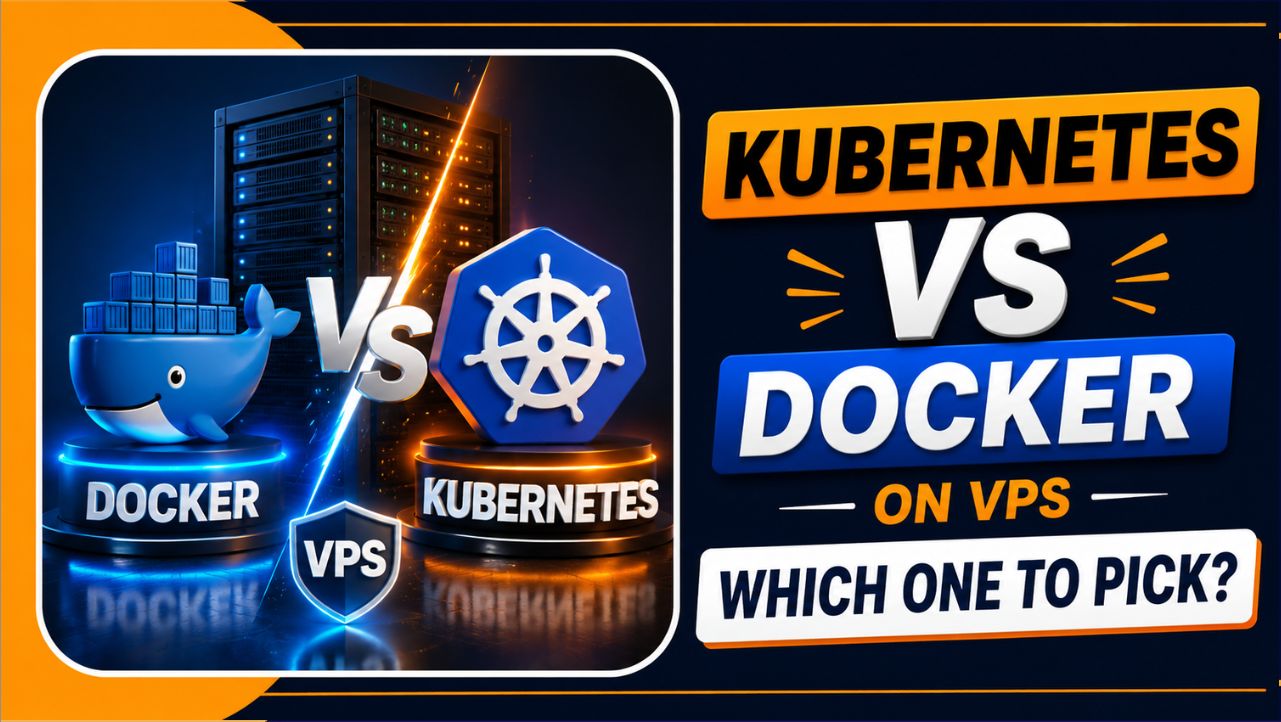
Let me tell you the truth! It is that Docker and Kubernetes are not rivals. They do two different jobs.
| Docker: packs your app. | Kubernetes: runs your apps |
You are reading this because you need to pick one for your VPS. Maybe you run a blog. Maybe you run a growing app. Your use case decides what you’ll choose. By the end, you will know exactly which tool fits your project. You will get a plain, honest use-case verdict.
I wrote this guide for beginners and newbie developers. You do not need to be a server expert. I explain every term in simple words as we go from scratch.
| Quick Note: Docker builds and runs your containers on a VPS. Kubernetes manages many containers across servers at scale. • Small projects pick Docker. • Large, growing apps pick Kubernetes. Many teams use both together. |
Quick Comparison Table: Docker vs Kubernetes
Let me give you the full picture in one glance.
This table shows how Kubernetes vs Docker on VPS build up on the points that matter most for real projects.
| Point | Docker | Kubernetes |
|---|---|---|
| Main job | Packs and runs containers | Manages containers at scale |
| Best for | Small to mid projects | Large, growing apps |
| Setup time | Minutes | Hours to days |
| RAM overhead | Around 50 MB | 2 GB to 4 GB |
| Auto scaling | Manual | Automatic |
| Self healing | Basic restart | Full auto recovery |
| Cost on VPS | Very low | Higher |
| Team size | 1 to 3 people | 3 plus with DevOps |
Read that table twice.
It answers most of your doubts already. Now let me break down each tool in plain words so the choice feels natural to you.
What Is Docker?
Docker is a tool that packs your app into a container.
A container bundles your code with everything it needs to run like libraries and dependencies.
It shares the host’s operating system, which keeps it lightweight and quick to start.
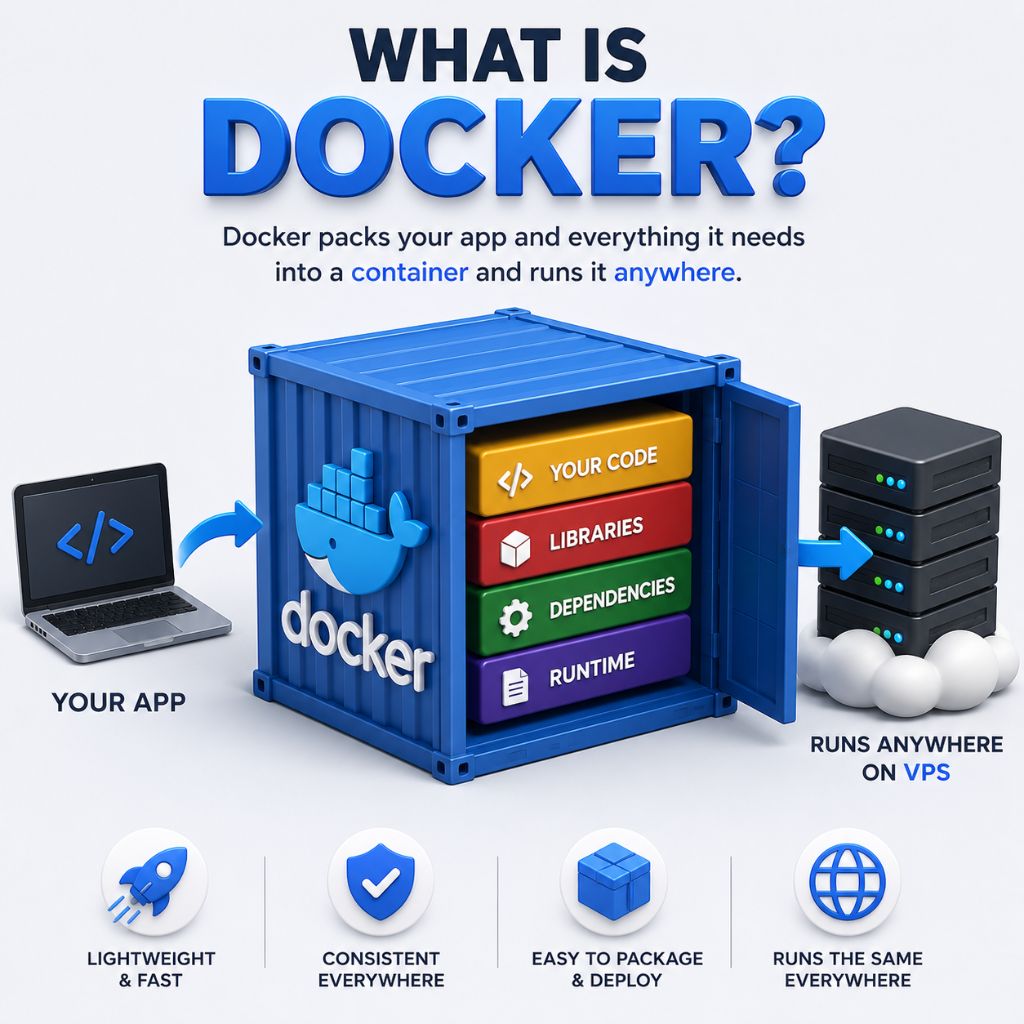
Think of it like a lunchbox. Your food, spoon and napkin in one box. You carry it anywhere and it just works the same way.
Docker solves the classic problem of code that runs on your laptop but breaks on the server.
The container carries the same setup everywhere it goes.
On a VPS, Docker is light and quick. You install it in seconds. Then you run your app with one simple command on your VPS hosting plan.
- Most developers use Docker every day to build and test apps. It became the standard way to package software across the whole industry.
- Docker also gives you Docker Compose (we’ve talked about it later in the article). This lets you run several linked containers, like a web app and a database, from one clean file.
How Docker Works on a VPS
Let me show you the Docker flow in plain steps:
| You do not need to memorize commands. Just grasp the simple idea behind each stage. |
- First, you write a small file that lists your app and its needs. Docker reads that file and builds an image, a frozen copy of your app.
- Next, you run that image as a container on your VPS. The container starts in seconds and behaves the same way on any machine.
- With Docker Compose, you list several containers in one file. One command then starts your web app and database in the right order.
That is the whole loop. Build the image, run the container, repeat. This speed is why so many developers love Docker on a VPS.
Ready to deploy Docker on your VPS? Follow our Docker VPS Setup Guide for a fast, step-by-step installation and hassle free container deployment.
What Is Kubernetes?
Kubernetes is a tool that manages many containers at once. People often call it K8s for short. It runs your containers across one or more servers.
Think of a busy sea port. Thousands of shipping boxes arrive daily. The port controls where each box goes and keeps all the traffic smooth. Kubernetes plays that port role. It starts containers, restarts crashed ones, and spreads load. It does all this on its own once set up.
Google built the first version and later gave it to the open community. The latest stable release is version 1.35 as of now.
On a VPS, plain Kubernetes needs real power. The control brain alone wants 2 GB to 4 GB of RAM before your app even starts to run. Kubernetes is good when you run many services that must stay online and scale fast. It handles traffic spikes that would break a single simple setup.
How Kubernetes Works on a VPS
Kubernetes works on a bigger idea. You tell it the state you want, and it works nonstop to reach and hold that state for you.
- You write a short file that says run three copies of my app. Kubernetes then starts three containers and watches them all closely.
- When one container crashes, Kubernetes starts a fresh one at once. You do nothing. The system heals itself in the background quietly.
- When traffic rises, Kubernetes can add more copies on its own. When traffic falls, it removes the extra copies to save your money.
It also spreads requests across all copies so none get flooded. This steady control is the true heart of Kubernetes on a VPS.
If you’ve decided that Kubernetes is the right choice for your project, the next step is to setup a Kubernetes cluster on your VPS. Follow our complete guide to install Kubernetes using kubeadm or k3s, configure networking, and deploy your first workload.
Real Difference Between Docker Vs Kubernetes on a VPS
Here is the point most guides bury. Docker and Kubernetes sit at two different stages of the same journey. One comes first. The other comes later.
Docker builds the container. It packs your app into that neat box and runs it on your VPS. That is its core job, from start to finish.
Kubernetes takes those boxes and runs a fleet of them. It decides which server holds which box and keeps them all healthy at once.
In simple terms, Docker is the shipping container. Kubernetes is the port that moves thousands of containers with order and full control.
So when you compare Kubernetes vs Docker on VPS, you compare a builder against a manager. They belong to the same team, not opposite sides.
| Factor | Docker | Kubernetes |
| Core job | Builds and runs the container | Orchestrates many containers |
| Stage in the journey | Comes first | Comes later |
| Simple analogy | The shipping container | The port moving thousands of containers |
| Role | The builder | The manager |
| Best fit | Small projects on one VPS | Large projects across many servers |
| Handles | Your site, database, and cache on a single server | Scaling, scheduling, and self-healing at scale |
| Server scope | Single VPS | Server clusters |
| Cost profile | Very low, minimal overhead | Higher, justified by scale |
| Traffic level | Light to moderate | Heavy and variable |
| Setup effort | Quick to start | Steeper, needs orchestration knowledge |
Docker and Kubernetes solve two different problems on a VPS.
Docker handles the build and run of a single container. Kubernetes handles the coordination of many containers across many servers. One packs your app into a box. The other runs a group of those boxes and keeps them healthy.
The table below breaks down where each tool sits, so you can match the right one to the size of your project.
Docker on a VPS: Pros and Cons
| Pros | Cons |
|---|---|
| Very light on memory | Manual scaling only |
| Sets up in minutes | Limited self healing |
| Runs on cheap VPS plans | |
| Gentle learning curve | |
| Large community and guides | |
| Great for single-server apps |
Kubernetes on a VPS: Pros and Cons
| Pros | Cons |
|---|---|
| Automatic scaling | Heavy memory demand |
| Strong self healing | Higher monthly cost |
| Runs across many servers | Slow, complex setup |
| Built-in load spread | |
| Zero downtime updates | |
| Handles huge traffic spikes |
See the pattern here. Kubernetes fixes every Docker weakness at scale. It also adds cost and effort that a small project simply does not need.
Docker Swarm: What is it?
Here is an option many readers miss.
Docker Swarm sits between plain Docker and full Kubernetes. It adds light orchestration to Docker itself.
Swarm lets you run containers across a few servers with basic scaling and healing. It uses the same Docker commands you already know well. So, nothing new at all!
The setup is far simpler than Kubernetes. You can turn a group of VPS servers into a small cluster in just a few minutes.
Swarm fits teams that want more than a single-server Docker but find Kubernetes too heavy. It gives you room to grow at a gentle speed.
Resource and Cost Comparison on a VPS
Money and memory decide many real choices.
My team ran both on the same VPS hardware and tracked the true cost. The gap surprised many of our readers.
Docker Compose barely touches your resources. It uses around 50 MB of RAM on top of your app. A 5 dollar VPS runs it with plenty of room to spare.
Plain Kubernetes tells a very different story.
| Item | Docker | Kubernetes |
|---|---|---|
| Base RAM need | Around 50 MB | 2 GB to 4 GB |
| Starter VPS cost | $5 to $10 per month | $20 to $40 per month |
| Setup time | Minutes | Hours to days |
| Managed option | Rare | $10 plus compute |
| Best team size | 1 to 3 people | 3 plus with DevOps |
Look at that cost jump.
A lightweight K3s setup can lower it, yet Docker still wins on price for small projects.
If you’re looking for the best VPS hosting for docker in that case, you can go with YouStable. The prices are highly affordable (starts @ $3.67 per month). Plus you even get full admin access via SSH secure root key and get 24/7 support at times of issues.
| Please Note: These costs mentioned above come from our 2026 tests on common VPS providers like YouStable. Real prices shift by provider, region, and plan. Treat them as a fair guide, not fixed quotes. |
Performance Under Load: Our Test
My research team pushed both setups under heavy traffic. We wanted real numbers. The results shaped every tip in this guide.
- On a single VPS, Docker held up well for steady traffic. It served our test app quickly until the load grew past one server’s limit.
- When we flooded the app with sudden spikes, plain Docker slowed down. It cannot add more copies on its own during a heavy rush.
- Kubernetes handled the same spikes with ease. It added copies fast, spread the load, and kept response times low across the whole test.
This gap matters only at a real scale. For small and steady sites, Docker felt fast and smooth throughout every single test we ran.
| Pro Tip: Test your app under real traffic before you pick. Many projects never hit the scale where Kubernetes pays off. Measure first, then decide with facts. |
Security: Docker vs Kubernetes on a VPS
Security matters on every VPS, and the two tools differ here. Let me keep this simple and practical for your real setup.
- Docker keeps each container walled off from the others. This isolation is solid for small setups when you keep your images clean and updated.
- Kubernetes offers deeper control over who can do what. It adds fine rules, secrets handling, and network limits across your whole cluster.
That power also brings a larger surface to guard. More parts mean more settings to lock down, so plan your security with real care.
For a small VPS, Docker with good habits stays safe enough. For large clusters, Kubernetes gives the controls that big teams truly need.
Managed Kubernetes or Self-Hosted?
One more choice is left for the Kubernetes fans. You can run it yourself on a VPS or pay a provider to manage the hard parts for you.
- Self-hosted Kubernetes on a VPS costs less in cash. You control every piece, yet you also carry every update, fix, and late-night alert alone.
- Managed Kubernetes hands the control brain to a provider. It costs 70 to 80 dollars a month or more, plus the price of your compute nodes.
For a small team, self-hosted K3s on a VPS keeps costs low and skills sharp. For a busy team, managed service buys back precious time.
Weigh your time against your budget here. Both paths reach the same result, so pick the one that fits your team’s real strength.
Which One Should You Pick on a VPS?
This is the part you came for. Your use case picks the winner, not the trend. Let me match each common case to the right tool very clearly.
For a Small Website or Blog
A blog or small site needs one thing: to stay online at low cost. Docker on a VPS wins here with total ease.
One small VPS runs your site, database, and cache in linked containers. Setup takes minutes and the monthly bill stays tiny.
Kubernetes would only add weight and cost you do not need. Skip it for this case and enjoy the simple, calm path instead.
For a Startup or Small SaaS
A young startup moves fast and watches every dollar. Docker Compose on a single strong VPS serves most early SaaS apps very well.
Many famous founders run large products on plain Docker. One well-known builder serves over 2 million monthly visitors from a single Docker server.
For a Growing App With Many Services
Your app now has many services that deploy on their own. Traffic climbs and one server feels tight. This is the real turning point.
You gain auto scaling and self healing that Docker alone cannot match. The extra effort now pays you back in stability and calm nights.
For a Large Scale Product
A large product runs dozens of services across many teams. Uptime is sacred and traffic spikes are normal. Only real orchestration can cope here.
Kubernetes is the clear pick at this scale. It spreads load, heals crashes, and rolls updates with zero downtime for all your users.
Docker still lives inside this setup as the container builder. You use both, each in its right role, for one smooth end result.
For Learning and Testing
You want to learn containers and test small ideas fast. Docker is the friendly place to begin your whole journey.
It runs on any cheap VPS and teaches you the core ideas. You build, run, and break things at a very low cost indeed.
Once containers feel natural, set up K3s to taste Kubernetes. This gentle path saves you from early stress and wasted money.
Can You Use Docker and Kubernetes Together?
Yes, you can use Docker and Kubernetes together and most real teams do exactly that only. They actually work as a very strong pair.
- Docker builds your container image on your machine or VPS. Kubernetes then takes that image and runs it across your cluster at full scale.
- Think of it as build, then manage. Docker handles the first half. Kubernetes handles the second half once your app grows large.
- Most Kubernetes clusters still run images built in Docker. The two tools share the same roots and speak the same core language.
So the honest answer to Kubernetes vs Docker on VPS is often both. You start with Docker and add Kubernetes when your scale truly demands it.
Common Mistakes People Make
My team sees the same issue again and again. Let me flag them so you keep in mind the pains we watched other users go through.
The biggest mistake is reaching for
- Kubernetes too early: Many teams adopt it before they have any real scale to justify the cost.
- Taking a VPS for Kubernetes alone: You must size it for Kubernetes plus your app, or things grind to a halt.
- Users pick plain Kubernetes when K3s would do: The lighter version saves memory and money on a modest VPS with the same core powers.
- Fear of Docker at scale: Docker plus Compose carries a real business further than most founders expect before any cluster is needed.
FAQs
Is Kubernetes better than Docker?
Both are good in their place. They do different jobs. Docker builds and runs containers. Kubernetes manages many containers at scale. Small projects pick Docker. Large, growing apps pick Kubernetes. Many teams use both together for the full workflow.
Can I run Kubernetes on a small VPS?
No! Plain Kubernetes needs 2 GB to 4 GB of RAM just for its control brain. A small VPS struggles with that load.
Do I need Docker to use Kubernetes?
Yes! You need containers and Docker is the common way to build them. Most Kubernetes clusters run Docker-built images. You can use other builders too, yet Docker stays the easiest and most popular starting point for beginners.
Which is cheaper on a VPS?
Docker is far cheaper. It runs on a $5 VPS with about 50 MB of overhead. A basic Kubernetes setup often costs 40 to 60 dollars per month or more. For small projects, Docker wins on price by a wide margin.
Is Docker enough for production?
Yes, for many real apps. Docker with Compose runs live SaaS products serving millions of visits from one server. It is good for production until you need scaling across many servers.
When should I switch to Kubernetes?
You should switch to Kubernetes once you pass five to ten services with real scaling needs. Growing traffic and strict uptime goals are the clear signals that tell you that you should switch.
Which should a beginner learn first?
Learn Docker first. It is simpler and forms the base for everything else. Once you are comfortable with containers, move to Docker Compose, then step up to Kubernetes as your projects grow in size.
What is Docker Swarm used for?
Docker Swarm adds light orchestration to Docker itself. It runs containers across a few servers with basic scaling and self healing.
Does Kubernetes replace Docker?
Not at all. Kubernetes manages containers, and it still needs an image built the Docker way. The two work as a pair. Docker builds and packs your app, while Kubernetes runs and scales it across many servers.
Is K3s good for production?
Yes, K3s runs real production workloads well. It brings rolling updates, health checks, auto restart, and Ingress with SSL to a VPS. It uses far less memory than full Kubernetes, so it fits a modest server nicely.
Conclusion: Which One Should You Pick?
Let me pull it all together in plain words.
The Kubernetes vs Docker on VPS choice comes down to your scale, your budget and your team.
- Pick Docker when you run a blog, a small site or an early startup. It is light, cheap, quick to set up and good for beginners.
- Pick Kubernetes when you run many services with heavy traffic and strict uptime. It scales, heals, and updates on its own once in place.
For most readers on a single VPS, Docker is the smart first step. You can always add Kubernetes later when your growth truly demands it.
Remember, these two tools are partners, not competitors to each other. Docker packs your app. Kubernetes runs it at scale. Together they cover the full journey.
My team built this guide from real tests on real VPS hardware. Use it to pick with confidence and skip the costly trial and error for good.