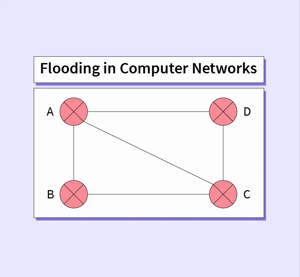
Flooding in computer networks is a simple forwarding algorithm where a node forwards an incoming packet out of every interface except the one it arrived on. This guarantees delivery when routes are unknown, but can create duplicates and loops.
Modern networks control flooding with TTL/hop counts, sequence numbers, and loop prevention, and use it in ARP, discovery, and link state routing. If you’ve ever wondered why some packets “seem to go everywhere,” the answer is the flooding algorithm.
In this guide, we’ll explain flooding in computer networks in practical, beginner friendly terms, show how it’s controlled in real deployments, and share best practices we use in hosting grade networks like those at YouStable.
What Is Flooding in Computer Networks?
Flooding in computer networks is a packet forwarding method used when nodes lack complete routing information or when immediate, widespread delivery is required. When a switch or router floods, it forwards a frame or packet out of all outgoing interfaces (except the ingress port). The goal is reachability and discovery, not efficiency.
Two broad forms exist:
- Uncontrolled (naive) flooding: forwards every copy to every neighbor indefinitely, causing heavy duplication and loops.
- Controlled flooding: uses mechanisms such as TTL/hop count, reverse path checks, sequence numbers, spanning tree, or acknowledgments to limit duplicates and terminate propagation safely.
Why Flooding Exists: The Core Use Cases
- Initial discovery: Learn unknown destinations at Layer 2 (e.g., ARP requests) or bootstrap services.
- Reliable topology sharing: Link state routing protocols (OSPF, IS-IS) flood updates so every router builds an identical database.
- Service or peer discovery: DHCP, some overlay/gossip systems, and cluster membership protocols rely on broadcast/multicast style dissemination.
How the Flooding Algorithm Works
Naive Flooding (Uncontrolled)
In naive flooding, every node forwards a received packet to all neighbors (except the sender) without any suppression. This ensures wide reach but creates duplicates, consumes bandwidth, and can loop forever on cyclic topologies, leading to broadcast storms.
Controlled Flooding Techniques
- TTL/Hop Count: Each packet carries a time to live (TTL) or hop count that decreases at each hop. When it hits zero, forwarding stops, preventing infinite loops.
- Sequence Numbers and Duplicate Suppression: Packets carry unique IDs (source + sequence). Nodes cache recent IDs and drop duplicates. Used by link state protocols (e.g., OSPF LSAs, IS-IS LSPs).
- Reverse Path Forwarding (RPF): Forward only if the packet arrived on the interface you’d use to reach the source. This prunes loops in multicast and some flooding schemes.
- Spanning Tree (STP/RSTP/MSTP): At Layer 2, switches compute a loop free tree. Frames are flooded along that tree only, preventing L2 loops.
- Acknowledged Flooding: Protocols like OSPF/IS-IS add reliability with acks, retransmissions, and aging so all nodes converge on the same database.
Flooding Across Layers: L2, L3, and Overlays
Layer 2 Switching: Broadcast and Unknown Unicast Flooding
Switches flood frames when the destination MAC is unknown or when the frame is a broadcast (e.g., ARP request). Without control, L2 loops can amplify traffic into a broadcast storm. STP family protocols prevent loops by blocking redundant links and maintaining a loop free topology. Storm control features rate limit broadcasts and multicasts.
Link State Routing: OSPF and IS-IS Flooding
OSPF and IS-IS flood link state advertisements (LSAs/LSPs) so every router builds the same link state database (LSDB). Reliability is ensured via sequence numbers, aging, checksums, and explicit acknowledgments. Scope is controlled by areas/levels to limit propagation. This controlled flooding underpins fast, loop free path computation via Dijkstra’s SPF.
Modern Data Center Fabrics and Overlays
Technologies like TRILL and SPB use IS-IS flooding to maintain topology. VXLAN EVPN reduces L2 flooding by moving learning to the control plane (BGP EVPN), but limited flooding may still occur for certain unknowns or ARP/ND, often mitigated by ARP suppression and proxy mechanisms.
Pseudocode: A Simple Controlled Flooding Algorithm
The following pseudocode illustrates core controls: TTL, duplicate suppression, and reverse path checks to keep flooding safe and efficient.
# Data structures
# seen[ (source_id, seq) ] = time_seen
# routing[source_id] = best_interface_toward_source
# neighbors = list of interfaces

on_packet_receive(packet, ingress_if):
    # Basic validations
    if packet.ttl <= 0:
        drop(packet); return

    key = (packet.source_id, packet.sequence)
    if key in seen:
        drop(packet); return
    seen[key] = now()

    # Optional reverse-path check
    if routing.get(packet.source_id) and routing[packet.source_id] != ingress_if:
        drop(packet); return

    # Process locally if needed
    process_if_relevant(packet)

    # Decrement TTL to limit propagation
    packet.ttl -= 1
    if packet.ttl == 0:
        return

    # Forward to all neighbors except ingress
    for ifc in neighbors:
        if ifc == ingress_if:
            continue
        send(packet.clone(), ifc)
Advantages and Disadvantages
Pros
- Guaranteed reachability when routing is unknown or incomplete.
- Fast dissemination of critical state (e.g., link-state) to all nodes.
- Simplicity in basic form; easy to implement and reason about.
- Robustness to single path failures since packets fan out across multiple paths.
Cons
- Duplicate traffic increases bandwidth and CPU utilization.
- Risk of storms due to loops or misconfiguration at Layer 2.
- Scalability limits without controls such as areas, RPF, and suppression.
- Security exposure if attackers exploit broadcast domains or flood control planes.
Common Problems: Broadcast Storms and Loops
Causes
- Layer 2 loops from accidental cabling or disabled STP.
- Excessive broadcast from misbehaving hosts (e.g., ARP floods).
- Misconfigured link aggregation (LACP off on one end) causing duplicates.
- Rogue DHCP servers or malware generating high broadcast traffic.
Symptoms and Business Impact
- High CPU on switches/routers and microbursts filling buffers.
- Packet loss, latency spikes, and application timeouts.
- Control plane instability, routing flaps, and loss of management access.
- Tenant isolation breaches in multi tenant environments if not segmented.
Prevention and Mitigation
- Enable STP/RSTP/MSTP and features like BPDU Guard, Root Guard, and Loop Guard.
- Use Storm Control to rate limit broadcast, unknown unicast, and multicast (BUM) traffic.
- Segment networks with VLANs, VRFs, and smaller L2 domains; favor L3 boundaries.
- Harden ARP/ND with ARP inspection, DHCP snooping, and IPv6 RA Guard.
- Monitor continuously with NetFlow/sFlow, SPAN, and syslog to catch early signs.
Flooding vs Broadcasting vs Multicasting
- Flooding: A forwarding behavior, send on all interfaces when destination is unknown or for controlled dissemination.
- Broadcasting: Send to all hosts in a broadcast domain (e.g., ARP request to ff:ff:ff:ff:ff:ff or 255.255.255.255).
- Multicasting: Send to a subscribed group; uses group management and often RPF/pruning to control scope.
Real World Examples
Host and Service Discovery
ARP requests (IPv4) and Neighbor Solicitation (IPv6) are flooded/broadcast within the L2 domain to find MAC addresses. DHCP Discover messages are also broadcast so servers can respond with configuration parameters.
Link State Routing Convergence
OSPF/IS-IS flood LSAs/LSPs quickly after a link change. Routers acknowledge and synchronize databases, then run SPF to compute new best paths. Areas/levels and LSA types limit the scope and volume to keep large networks stable.
Gossip and Overlay Systems
Some distributed systems use gossip like dissemination to share membership or health data. While not pure flooding, many borrow flooding controls TTL, sequence IDs, and duplicate suppression to balance reachability with efficiency.
Best Practices for Network Engineers and Hosting Providers
Design for Control, Not Just Reach
- Prefer smaller L2 domains and build at Layer 3 for scale and resilience.
- Enable RSTP/MSTP and hardened STP features on all access/aggregation switches.
- Use ARP/ND suppression and EVPN control plane learning in VXLAN fabrics to minimize L2 flooding.
- Apply storm control, broadcast rate limits, and CoPP (Control Plane Policing) on routers.
- Structure routing with areas/levels and summarize where appropriate to reduce LSA scope.
Monitor and Troubleshoot Proactively
- Baseline normal BUM traffic; alert on anomalies.
- Track LSA rates, SPF runs, and neighbor flaps in OSPF/IS-IS.
- Use port counters and flow sampling to pinpoint sources of broadcast surges.
Example commands you might use during troubleshooting:
# Cisco IOS-XE examples
show spanning-tree detail
show storm-control interface status
show ip ospf neighbor
show ip ospf database
show processes cpu sorted

# Juniper Junos examples
show spanning-tree interface
show ethernet-switching statistics
show ospf neighbor
show ospf database
show system processes extensive
Security Considerations: When Flooding Becomes an Attack
Threats
- Broadcast amplification (e.g., legacy Smurf style ICMP to broadcast).
- ARP cache poisoning in flat L2 domains to redirect traffic.
- Control plane exhaustion by triggering excessive routing updates or neighbor churn.
Hardening Checklist
- Enable DHCP Snooping, Dynamic ARP Inspection, and IP Source Guard at the access layer.
- Apply ACLs to block directed broadcasts and unnecessary L2/L3 protocols.
- Use CoPP to protect routing CPUs from storms.
- Isolate tenants via VLANs/VRFs; avoid oversized broadcast domains.
- Keep firmware updated and enforce port security on edge ports.
How YouStable Designs Against Harmful Flooding
At YouStable, our hosting network minimizes uncontrolled flooding with small L2 fault domains, RSTP with strict guards, storm control at access, and EVPN/VXLAN with ARP suppression in modern fabrics. In the routing core, OSPF/IS-IS flooding is scoped and policed for stability. The result is predictable performance even under failure or discovery bursts.
FAQs
Is flooding the same as broadcasting?
No. Broadcasting targets all hosts in a broadcast domain. Flooding is a forwarding behavior: a device forwards a frame or packet out all ports except the ingress when the destination is unknown or when a protocol intentionally disseminates information widely.
What prevents flooding loops at Layer 2?
Spanning Tree Protocol (STP), Rapid STP (RSTP), and MSTP compute a loop free topology. Additional protections like BPDU Guard, Root Guard, and Loop Guard keep the tree stable and prevent accidental loops.
How do OSPF and IS-IS control flooding overhead?
They use sequence numbers, aging, checksums, and acknowledgments to ensure reliability without infinite duplication. Areas (OSPF) or levels (IS-IS) constrain the scope of flooding, and incremental updates reduce churn.
What is a broadcast storm?
A broadcast storm is a surge of broadcast/unknown unicast/multicast (BUM) traffic often fueled by L2 loops that saturates links and device CPUs. It causes packet loss, latency, and outages. Storm control, STP, and segmentation are the primary defenses.
When should I avoid flooding entirely?
Avoid flooding across large or latency-sensitive domains. Prefer EVPN control-plane learning, ARP/ND suppression, and L3 boundaries. In security-conscious environments, tightly restrict broadcast and apply CoPP and ACLs.
Does VXLAN EVPN eliminate flooding?
It greatly reduces it by advertising MAC/IP bindings in BGP EVPN. However, limited flooding can still occur for unknowns or specific control traffic. ARP suppression and proxy services further minimize it.
Key Takeaways
- Flooding in computer networks ensures reach, but must be controlled to avoid storms.
- Use TTL, sequence numbers, RPF, and loop-free topologies to keep flooding safe.
- Real networks rely on flooding for discovery and link-state routing; scope it for scale.
- Design small L2 domains, leverage EVPN, and harden the edge to reduce risk.
- Continuous monitoring is essential to detect anomalies early and maintain performance.
Understanding the flooding algorithm and deploying the right controls, lets you build faster, safer, and more scalable networks. If you need a hosting platform engineered with these best practices, YouStable’s infrastructure is built to keep flooding in check and performance on point.