When you buy VPS hosting, one important thing works silently behind the server, and that is virtualization technology. But here many users get confused. Some hosting providers use KVM, some use VMware ESXi, and many people also hear the word VMware without understanding the real difference between them.
Now you may ask, “Which virtualization platform actually gives better performance, stronger security, lower costs, and smoother VPS management?” The answer depends on what type of hosting environment, workloads, and infrastructure goals you have. A small VPS hosting setup and a large enterprise cloud infrastructure usually require very different virtualization solutions.
That is exactly what this comparison will help you understand in a simple and practical way. Here you will learn how KVM, VMware ESXi, and the VMware ecosystem work, where each platform performs better, their advantages, limitations, pricing differences, cloud compatibility, security features, and which virtualization technology fits different VPS hosting environments more effectively.
What Is Virtualization in VPS Hosting?
When you buy VPS hosting, you are not actually getting a completely separate physical server. Instead, one powerful physical server is divided into multiple virtual servers using virtualization technology.
These virtual servers are called VPSs or Virtual Machines (VMs).
Now a question comes to mind: How can one server run so many VPS servers together at the same time?
This is possible because virtualization separates server resources like:
- CPU
- RAM
- Storage
- Network bandwidth
into multiple isolated environments.
So every VPS works independently with its own:
- Operating system
- Files
- Applications
- User access
- Resources
That is why your VPS behaves almost like a real dedicated server even though other VPS instances may also be running on the same physical machine.
For example, one powerful server can host:
- Linux VPS servers
- Windows virtual machines
- Game servers
- Development environments
- Business websites
- Cloud applications
The software layer that manages all this is called a hypervisor. It controls virtualization, resource allocation, VM isolation, and server management.
There are two main types of hypervisors:
| Hypervisor Type | Description |
| Type 1 Hypervisor | Runs directly on physical server hardware |
| Type 2 Hypervisor | Runs on top of another operating system |
KVM and VMware ESXi are both Type 1 hypervisors, which is why they provide better performance, stronger stability, and higher efficiency for VPS hosting environments in 2026.
What Is KVM?
into the Linux kernel. KVM allows one physical server to run multiple isolated virtual machines with dedicated virtual resources like CPU, RAM, storage, and networking.
KVM became highly popular in VPS hosting because it provides strong performance, better scalability, lower operational costs, and excellent Linux compatibility. Many modern cloud providers and OpenStack based infrastructures use KVM for efficient and flexible virtualization environments.
KVM offers:
- Near bare metal performance – Virtual machines perform very close to actual physical server hardware in real hosting environments.
- Strong security isolation – Each VPS remains isolated from other virtual machines for improved stability and security protection.
- Open source flexibility – Hosting providers can customize virtualization infrastructure freely without expensive enterprise licensing restrictions.
- Excellent scalability – KVM handles growing VPS infrastructures efficiently without major performance or resource management issues.
- Wide Linux support – KVM works extremely well with most Linux distributions used in modern VPS hosting.
- Lower infrastructure costs – Open source licensing helps reduce operational expenses for hosting companies and cloud providers.
- Efficient resource management – CPU, RAM, storage, and networking resources are allocated efficiently between virtual machines.
- Better cloud compatibility – KVM integrates smoothly with OpenStack, Kubernetes, and modern cloud automation platforms.
Key Features of KVM
KVM is widely used in modern VPS hosting because it combines strong performance, flexibility, scalability, and security. These features make KVM suitable for both small hosting businesses and large cloud infrastructures.
1. Near Bare Metal Performance
KVM is known for delivering performance very close to physical server hardware. This helps virtual machines run smoothly even under heavy workloads and high resource usage.
KVM uses Intel VT-x and AMD-V virtualization technologies, allowing virtual machines to access hardware resources more efficiently. This makes KVM highly suitable for:
- High traffic websites
- Database servers
- Game hosting
- Streaming platforms
- Container workloads
- Cloud applications
2. Full Virtualization
One major advantage of KVM is full virtualization support. Every virtual machine runs independently with its own operating system, kernel, applications, and files.
KVM supports:
- Linux VPS hosting
- Windows VPS hosting
- BSD systems
- Custom operating systems
This flexibility allows hosting providers to run multiple types of workloads efficiently on the same physical server.
3. Open Source Flexibility
KVM is completely open source, which gives hosting companies more control over virtualization infrastructure and server management.
Providers can customize:
- Networking
- Storage
- Automation
- Resource allocation
- Server configurations
This flexibility is one major reason many cloud hosting providers prefer KVM over expensive commercial virtualization solutions.
4. Strong Security Isolation
Security isolation is another important reason why KVM is trusted in VPS hosting environments. Each virtual machine remains separated from other VPS instances using Linux kernel security technologies.
If one VPS becomes compromised or overloaded, other virtual machines usually remain stable and protected.
5. Excellent Scalability
KVM scales very efficiently in both small VPS setups and large enterprise cloud environments. It can manage growing workloads without major performance issues.
KVM works smoothly with:
- OpenStack
- Kubernetes
- Proxmox
- Virtualizor
- SolusVM
This makes KVM highly suitable for modern cloud hosting and scalable VPS infrastructures in 2026.
Advantages of KVM for VPS Hosting
KVM has become one of the most trusted virtualization technologies in VPS hosting because it combines strong performance, lower infrastructure costs, better Linux compatibility, and excellent scalability. Many modern hosting companies and cloud providers prefer KVM because it allows them to build flexible and cost effective VPS environments without depending on expensive enterprise licensing models.
Why Many VPS Hosting Providers Prefer KVM
KVM is highly suitable for modern VPS hosting infrastructures because it provides efficient resource management, strong virtual machine isolation, and smooth compatibility with cloud platforms. Its open source flexibility also gives hosting providers greater control over server management and infrastructure customization.
| Feature | Advantage | Why It Matters for VPS Hosting |
| Lower Costs | No expensive licensing fees | Helps hosting providers reduce operational and infrastructure expenses significantly. |
| Linux Integration | Deeply integrated into the Linux kernel | Delivers better performance and stability for Linux VPS hosting environments. |
| High Customization | Flexible virtualization configurations | Providers can customize networking, storage, and automation systems easily. |
| Cloud Compatibility | Works smoothly with cloud platforms | Integrates efficiently with OpenStack, Kubernetes, and cloud automation tools. |
| Strong Performance | Efficient resource utilization | Handles websites, databases, APIs, containers, and SaaS workloads very effectively. |
| Better Scalability | Supports growing infrastructures | Makes it easier to expand VPS environments without major performance limitations. |
| Strong VM Isolation | Better workload separation | Improves security, stability, and protection between virtual machines. |
| Open Source Flexibility | Full infrastructure control | Hosting providers are not restricted by commercial virtualization licensing models. |
Disadvantages of KVM
Although KVM is highly popular in VPS hosting because of its performance, flexibility, and lower costs, it also has some limitations that hosting providers and businesses should consider before choosing it for virtualization infrastructure.
Common Limitations of KVM in VPS Hosting
KVM works extremely well for many hosting environments, but some areas may require additional technical knowledge, third party tools, or advanced server management experience compared to enterprise focused virtualization platforms.
| Limitation | Drawback | Why It Can Matter |
| Linux Learning Curve | Requires Linux administration knowledge | Beginners may find KVM server management more technical initially. |
| Advanced Setup Complexity | Manual configuration may be required | Networking, storage, and virtualization setups can become complicated in large environments. |
| Limited Built In Management Tools | Depends on third party panels | Providers often use Proxmox, Virtualizor, or SolusVM for easier infrastructure management. |
| Enterprise Support Dependency | Support varies by provider | Unlike VMware, enterprise grade support is not always centralized. |
| Windows Optimization Limitations | Better optimized for Linux workloads | Some Windows VPS environments may require additional tuning and drivers. |
| Management Flexibility Can Increase Complexity | Too many customization options | Infrastructure management may become difficult without experienced administrators. |
| Hardware Compatibility Considerations | Some configurations require optimization | Performance tuning may vary depending on server hardware and workloads. |
| Enterprise Ecosystem Limitations | Smaller enterprise ecosystem than VMware | Large enterprises may prefer VMware’s mature enterprise management ecosystem. |
What Is VMware ESXi?
VMware ESXi is a bare metal enterprise hypervisor developed by VMware. It installs directly on physical server hardware and allows multiple virtual machines to run efficiently on the same system without needing a traditional operating system underneath.
VMware ESXi is widely used in enterprise environments because it provides strong stability, advanced virtualization management, and reliable infrastructure performance. Many organizations prefer ESXi for managing large virtual infrastructures with centralized control and high availability support.
VMware ESXi is commonly used in:
- Enterprise data centers
- Corporate IT infrastructures
- Financial organizations
- Healthcare systems
- Large hosting environments
- Enterprise cloud platforms
Why VMware ESXi Is Popular in Enterprise Virtualization
VMware ESXi is trusted by many enterprises because it offers advanced virtualization features, efficient resource management, and long term infrastructure stability. Its enterprise focused ecosystem makes managing large virtual environments easier and more organized.
| Feature | Advantage | Why It Matters for Enterprise Hosting |
| Enterprise Stability | Reliable virtualization platform | Helps reduce downtime in critical business and hosting environments. |
| Advanced VM Management | Easy virtual machine administration | Simplifies VM creation, migration, cloning, and resource management tasks. |
| Centralized Administration | Single dashboard management | Allows administrators to manage multiple servers more efficiently. |
| High Availability Features | Automatic VM recovery support | Improves uptime during hardware failures or infrastructure problems. |
| Strong Security Controls | Enterprise level security management | Helps protect virtual environments and sensitive business workloads. |
| Resource Optimization | Efficient hardware utilization | Balances CPU, RAM, and storage resources between virtual machines. |
| Enterprise Ecosystem | Wide VMware tool integration | Works smoothly with VMware vCenter, vSphere, and enterprise solutions. |
| Large Infrastructure Support | Handles enterprise scale environments | Suitable for large data centers and complex virtualization infrastructures. |
Key Features of VMware ESXi
VMware ESXi is widely trusted in enterprise virtualization because it provides strong stability, advanced virtual machine management, centralized infrastructure control, and reliable performance for large scale hosting environments.
Its enterprise focused features help organizations manage virtual machines more efficiently while maintaining better uptime, security, and resource optimization across complex infrastructures.
| Feature | Advantage | Why It Matters for Enterprise Hosting |
| Enterprise Stability | Reliable virtualization performance | Helps reduce downtime in mission critical business and hosting environments. |
| Advanced VM Management | Easy virtual machine administration | Simplifies snapshots, cloning, live migration, and backup management tasks. |
| vCenter Integration | Centralized infrastructure control | Allows administrators to manage multiple ESXi servers from a single dashboard. |
| High Availability | Automatic VM failover support | Improves uptime by restarting virtual machines during hardware failures automatically. |
| Intelligent Resource Scheduling | Better workload distribution | Optimizes CPU, RAM, storage, and networking resource allocation efficiently. |
| Strong Enterprise Security | Advanced infrastructure protection | Helps secure virtual machines and enterprise workloads more effectively. |
| Efficient Infrastructure Management | Simplified virtualization operations | Makes large enterprise environments easier to monitor and maintain regularly. |
| Large Scale Environment Support | Handles enterprise virtualization efficiently | Suitable for data centers, cloud infrastructures, and corporate IT systems. |
Advantages of VMware ESXi for VPS Hosting
VMware ESXi is widely trusted in enterprise virtualization because it provides strong infrastructure stability, advanced management tools, centralized administration, and reliable long term performance.
Many enterprises and large hosting environments prefer ESXi because it helps manage complex virtual infrastructures more efficiently while maintaining better uptime, security, and resource control.
Why Many Enterprises Prefer VMware ESXi
VMware ESXi is highly suitable for enterprise VPS hosting environments where reliability, centralized management, and infrastructure stability are extremely important. Its advanced virtualization ecosystem helps organizations manage large virtual environments with better control and operational efficiency.
| Feature | Advantage | Why It Matters for VPS Hosting |
| Excellent Reliability | Stable virtualization environment | Helps maintain long term uptime and consistent VPS performance in enterprise infrastructures. |
| Enterprise Features | Advanced virtualization tools | Supports large organizations with better VM management and infrastructure control. |
| Centralized Management | Easier multi server administration | VMware tools simplify managing multiple virtual machines and physical servers together. |
| High Availability Support | Better infrastructure continuity | Helps reduce downtime during server failures or hardware related issues automatically. |
| Mature VMware Ecosystem | Wide enterprise tool integration | Works smoothly with VMware vCenter, vSphere, and enterprise monitoring solutions. |
| Better Resource Optimization | Efficient hardware utilization | Improves CPU, RAM, storage, and networking resource management across virtual machines. |
| Enterprise Security Controls | Advanced workload protection | Helps secure sensitive business applications and enterprise VPS environments effectively. |
| Large Infrastructure Support | Handles enterprise scale virtualization | Suitable for data centers, enterprise clouds, and large hosting infrastructures efficiently. |
Disadvantages of VMware ESXi
VMware ESXi is highly reliable for enterprise virtualization, but its licensing costs, infrastructure complexity, and enterprise focused ecosystem may not suit every VPS hosting environment or smaller hosting business.
Common Limitations of VMware ESXi in VPS Hosting
VMware ESXi offers advanced enterprise virtualization features, but some limitations can increase operational costs and infrastructure management complexity for VPS hosting providers and growing cloud environments.
| Limitation | Drawback | Why It Can Matter |
| Expensive Licensing | Higher virtualization costs | VMware licenses can significantly increase operational expenses for hosting companies and enterprises. |
| Enterprise Focused Ecosystem | Complex infrastructure management | Smaller hosting providers may find VMware environments difficult to manage initially. |
| Lower Customization Flexibility | More controlled virtualization environment | Providers get less infrastructure flexibility compared to open source KVM virtualization platforms. |
| Additional Tool Costs | Enterprise tools require subscriptions | vCenter and other VMware products may increase total infrastructure investment costs. |
| Higher Hardware Requirements | Enterprise environments need powerful servers | Large VMware infrastructures may require higher end hardware for better virtualization performance. |
| Advanced Learning Curve | Enterprise administration knowledge required | Beginners may need time to understand VMware ecosystem management properly. |
| Vendor Dependency | Heavy reliance on VMware ecosystem | Organizations may become dependent on VMware specific enterprise virtualization solutions. |
| Costly Scaling | Expanding infrastructure increases expenses | Growing VMware environments can become expensive compared to open source virtualization alternatives. |
What Is VMware?
Many users think VMware and ESXi are separate virtualization technologies, but actually VMware is the company, while ESXi is one of its virtualization products used for enterprise server virtualization.
VMware provides a complete virtualization ecosystem designed for enterprise infrastructures, cloud environments, virtual machine management, and centralized administration. Its technologies are widely used in data centers, enterprise IT infrastructures, and large virtualization environments worldwide.
The VMware ecosystem includes:
- VMware ESXi
- VMware vSphere
- VMware vCenter
- VMware Workstation
- VMware Cloud solutions
VMware ESXi works as the main bare metal hypervisor, while tools like vCenter and vSphere help organizations manage large virtual infrastructures more efficiently. This is one major reason VMware remains highly popular in enterprise virtualization environments.
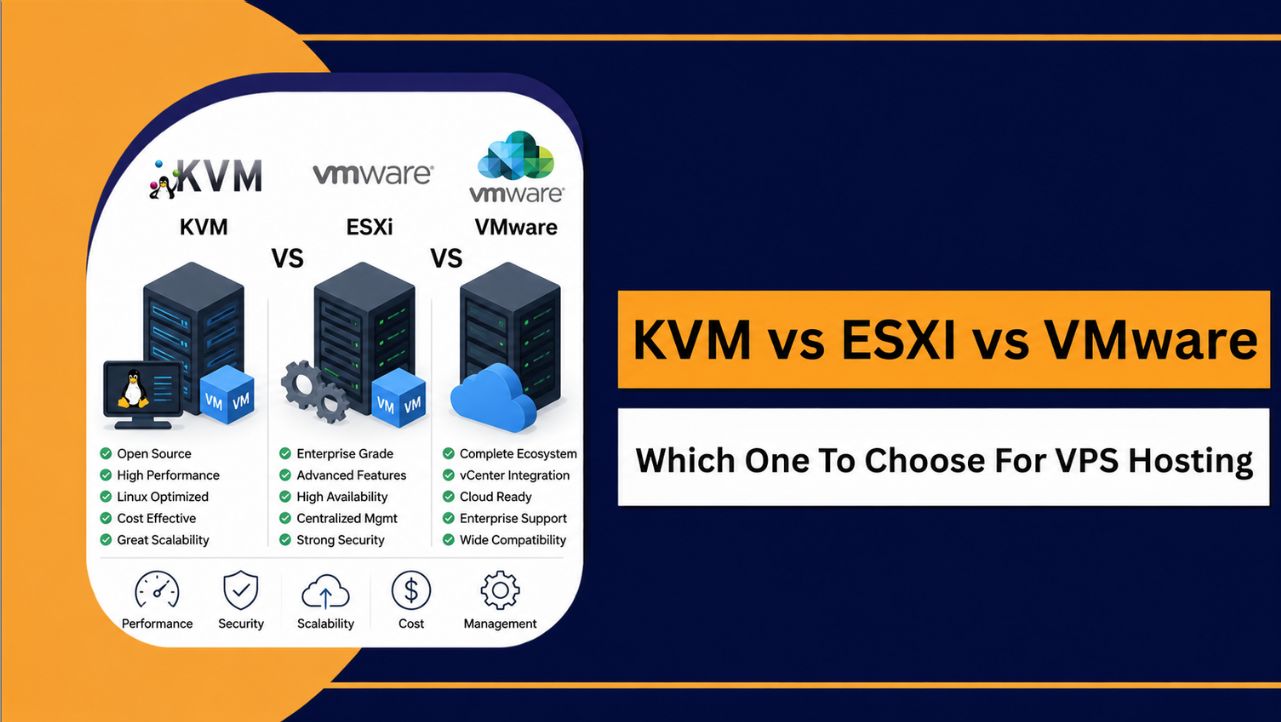
KVM vs ESXi vs VMware: Quick Comparison
KVM, VMware ESXi, and the broader VMware ecosystem are all powerful virtualization solutions, but they are designed for different hosting environments and infrastructure requirements.
KVM is highly popular in Linux VPS hosting and cloud platforms because of its flexibility and lower operational costs, while VMware ESXi is widely trusted in enterprise virtualization because of its centralized management, advanced enterprise tools, and infrastructure stability.
| Feature | KVM | VMware ESXi | VMware Ecosystem |
| Type | Open source Type 1 hypervisor | Bare metal enterprise hypervisor | Complete enterprise virtualization ecosystem |
| Pricing | Free and open source | Commercial licensing required | Subscription and enterprise based pricing |
| Performance | Near bare metal virtualization performance | Highly optimized enterprise virtualization performance | Enterprise grade infrastructure optimization |
| Linux Support | Excellent Linux compatibility | Strong Linux virtualization support | Wide enterprise Linux ecosystem support |
| Windows Support | Good Windows VM compatibility | Excellent Windows virtualization support | Advanced Windows enterprise integration |
| Ease of Use | Moderate learning curve | Easier enterprise virtualization management | Advanced enterprise infrastructure management |
| Best For | VPS hosting and cloud providers | Enterprise virtualization environments | Large enterprise infrastructures |
| Customization | Very high infrastructure flexibility | Moderate customization options | Controlled enterprise virtualization ecosystem |
| Cloud Compatibility | Excellent OpenStack compatibility | Strong enterprise cloud integration | Broad hybrid cloud infrastructure support |
| Automation Support | Strong automation flexibility | Advanced enterprise automation tools | Very strong infrastructure orchestration support |
| Scalability | Excellent for growing VPS infrastructures | Highly scalable enterprise virtualization | Large scale enterprise infrastructure management |
| Infrastructure Costs | Lower operational expenses | Higher enterprise infrastructure costs | Premium enterprise ecosystem pricing |
| Management Tools | Often uses third party panels | Integrated enterprise management tools | Full VMware enterprise management suite |
| Enterprise Ecosystem | Smaller enterprise ecosystem | Mature enterprise virtualization ecosystem | Complete enterprise infrastructure platform |
KVM vs ESXi Performance Comparison
Performance is one of the most important factors in VPS hosting because it directly affects website speed, server responsiveness, workload handling, and overall virtualization efficiency.
Both KVM and VMware ESXi provide excellent virtualization performance, but their strengths can vary depending on infrastructure type, operating systems, and hosting workloads.
| Performance Area | KVM | VMware ESXi |
| CPU Performance | Delivers near bare metal CPU performance through deep Linux kernel integration and efficient virtualization support. | Provides highly optimized enterprise CPU virtualization with slightly higher overhead in some environments. |
| RAM Management | Efficiently handles memory allocation and dynamic resource distribution across virtual machines. | Strong enterprise memory optimization with advanced workload balancing and VM resource management. |
| Disk I/O Performance | Performs exceptionally well in Linux based storage and optimized VPS hosting environments. | Excels in enterprise SAN storage integration and advanced enterprise storage infrastructures. |
| Network Virtualization | Supports VLANs, virtual switches, SDN integration, and advanced traffic management efficiently. | Provides enterprise grade networking tools with strong virtualization and centralized network control. |
| Linux Workloads | Highly optimized for Linux VPS hosting and cloud infrastructure environments. | Delivers strong Linux virtualization support in enterprise infrastructures. |
| Windows Workloads | Good Windows VM support with proper optimization and drivers. | Better optimized for enterprise Windows virtualization environments and workloads. |
| Container Performance | Works very efficiently with Kubernetes, Docker, and container based cloud infrastructures. | Supports containers well but focuses more on enterprise virtualization environments. |
| Scalability Performance | Handles growing VPS infrastructures efficiently with lower operational overhead. | Performs extremely well in large enterprise virtualization and centralized infrastructures. |
KVM vs ESXi Security Comparison
Security plays a major role in VPS hosting because virtualization environments often handle sensitive business data, websites, applications, and enterprise workloads.
Both KVM and VMware ESXi provide strong virtualization security, but KVM focuses more on Linux-based isolation technologies, while VMware ESXi focuses heavily on enterprise-grade security management and compliance features.
| Security Area | KVM | VMware ESXi |
| VM Isolation | Uses Linux kernel isolation technologies for strong virtual machine separation and workload protection. | Provides enterprise grade VM isolation with advanced virtualization security controls. |
| Security Features | Supports SELinux, AppArmor, cgroups, and namespaces for improved infrastructure security. | Includes secure boot, VM encryption, enterprise compliance tools, and advanced access controls. |
| Enterprise Compliance | Good security support for cloud hosting and Linux VPS environments. | Strong compliance focused security for enterprise and regulated industries. |
| Access Control | Linux based permission and virtualization security management. | Centralized enterprise access management with advanced administrative controls. |
| Best For | Linux cloud hosting and scalable VPS infrastructures. | Enterprise environments requiring advanced security management and compliance support. |
KVM vs VMware Pricing Comparison
Pricing is one of the biggest deciding factors in VPS hosting because virtualization costs directly affect infrastructure expenses, scalability, and long term hosting profitability. KVM is generally more affordable because it is open source, while VMware environments usually involve higher enterprise licensing and management costs.
| Pricing Area | KVM | VMware ESXi |
| Licensing Costs | Free and open source virtualization platform with no mandatory licensing expenses. | Requires commercial licensing for advanced enterprise virtualization features and management tools. |
| Infrastructure Expenses | Mainly includes hardware, Linux administration, and optional management panel costs. | Includes ESXi licenses, vCenter subscriptions, enterprise tools, and infrastructure management expenses. |
| Operational Costs | Lower long term operational expenses for VPS hosting providers and cloud platforms. | Higher operational costs due to enterprise ecosystem and licensing requirements. |
| Scalability Costs | More cost effective for expanding VPS and cloud infrastructures. | Infrastructure scaling can become expensive in large enterprise environments. |
| Best For Budget Hosting | Highly suitable for affordable VPS hosting and startup cloud infrastructures. | Better suited for enterprises prioritizing advanced management over lower costs. |
Which Is More Budget Friendly?
KVM is usually the more budget friendly option for VPS hosting because it is open source and does not require expensive enterprise licensing fees. VMware ESXi offers advanced enterprise management features, but its licensing, support subscriptions, and infrastructure costs are generally much higher for long term virtualization environments.
| Budget Factor | KVM | VMware ESXi |
| Licensing | Completely free and open source virtualization platform | Commercial licensing required for advanced enterprise features |
| Infrastructure Costs | Lower setup and operational expenses for hosting providers | Higher infrastructure and enterprise management costs |
| Long Term Scaling | More affordable for expanding VPS and cloud infrastructures | Scaling large environments can increase enterprise expenses significantly |
| Management Expenses | Mostly depends on Linux administration and optional panels | Requires additional VMware enterprise tools and subscriptions |
| Best For | Budget VPS hosting, startups, and cloud platforms | Enterprises needing advanced management and enterprise support |
KVM vs ESXi Ease of Management
Ease of management is important in VPS hosting because administrators need virtualization platforms that are simple to control, monitor, and scale efficiently. KVM and VMware ESXi both provide strong management capabilities, but their management approaches are different.
KVM Management
KVM management mainly depends on third party virtualization panels and Linux based administration tools for handling VPS infrastructures more efficiently.
- Proxmox – Popular KVM management panel that simplifies VPS creation, monitoring, backups, and virtualization administration tasks.
- Virtualizor – Lightweight VPS control panel used by hosting providers for managing virtual machines more easily.
- SolusVM – Helps hosting companies automate VPS deployment, resource management, and customer virtualization controls efficiently.
- High Flexibility – Advanced users prefer KVM because it allows deeper infrastructure customization and Linux level control.
VMware ESXi Management
VMware ESXi focuses heavily on centralized enterprise management and simplified administration for large virtualization infrastructures and business environments.
- VMware vCenter – Centralized management platform for handling multiple ESXi servers from one dashboard efficiently.
- vSphere Client – User friendly VMware interface for virtual machine monitoring, configuration, and infrastructure administration.
- Automation APIs – VMware supports advanced automation tools for enterprise virtualization management and infrastructure scaling.
- Simplified Enterprise Management – VMware tools make large virtualization environments easier to monitor and manage consistently.
Popular VPS Panels Compatible With KVM
KVM works smoothly with many VPS management panels that help hosting providers simplify virtualization management, automate VPS deployment, monitor resources, and manage cloud infrastructures more efficiently.
Most Popular KVM VPS Management Panels
- Proxmox VE – One of the most popular KVM virtualization platforms with powerful VM management, clustering, backup, and container support features.
- Virtualizor – Lightweight VPS control panel widely used by hosting providers for VPS creation, monitoring, and customer management automation.
- SolusVM – Popular VPS management platform designed for automating virtual machine deployment and hosting infrastructure management.
- OpenStack – Large scale cloud management platform commonly used for enterprise cloud infrastructures and scalable KVM virtualization environments.
- oVirt – Open source virtualization management platform that provides centralized management for KVM based infrastructures and enterprise environments.
- CloudStack – Cloud orchestration platform used for managing large virtualized cloud infrastructures with KVM hypervisors.
These management panels help simplify:
- VPS deployment
- Resource allocation
- VM monitoring
- Backup management
- Infrastructure automation
- Cloud virtualization management
This is one major reason KVM remains highly popular in modern VPS hosting and cloud infrastructure environments.
Which Is Better for VPS Hosting?
The better virtualization platform depends on your hosting goals, infrastructure size, budget, management requirements, and workload types. KVM is usually preferred for affordable cloud hosting and Linux VPS environments, while VMware ESXi is more suitable for enterprise infrastructures requiring advanced centralized management and enterprise grade stability.
Choose KVM If:
KVM is highly suitable for VPS hosting providers, cloud platforms, and businesses looking for affordable, flexible, and scalable virtualization environments.
- You want lower infrastructure costs – KVM is open source and helps reduce long term VPS hosting expenses significantly.
- You prefer open source virtualization – Hosting providers get more flexibility and infrastructure customization without expensive licensing restrictions.
- You run Linux heavy workloads – KVM performs exceptionally well with Linux VPS hosting and cloud infrastructures.
- You operate cloud hosting platforms – KVM integrates efficiently with OpenStack, Kubernetes, and modern cloud automation environments.
- You need high customization – Advanced users can customize networking, storage, and virtualization infrastructure more deeply.
Choose VMware ESXi If:
VMware ESXi works better for enterprises that require centralized virtualization management, enterprise grade reliability, and advanced infrastructure administration tools.
- You manage enterprise infrastructures – VMware ESXi is designed for large enterprise virtualization environments and centralized infrastructure management.
- You require advanced centralized administration – VMware tools simplify managing multiple servers, virtual machines, and enterprise workloads.
- Compliance and uptime are important – VMware provides enterprise grade security, high availability, and compliance focused virtualization features.
- Budget is less important than stability – Many enterprises prefer VMware for long term reliability and mature virtualization ecosystems.
Why Most Cloud Providers Prefer KVM
Many cloud hosting providers prefer KVM because it offers strong virtualization performance, open source flexibility, lower operational costs, and excellent compatibility with modern cloud infrastructures. KVM also integrates efficiently with platforms like OpenStack and Kubernetes, making it highly suitable for scalable VPS hosting and enterprise cloud environments.
| Reason | Why Cloud Providers Prefer KVM |
| Open Source Flexibility | Providers can customize virtualization infrastructure without expensive enterprise licensing restrictions. |
| Lower Infrastructure Costs | KVM helps reduce operational and long term virtualization expenses significantly. |
| Strong Linux Integration | Deep Linux kernel integration improves virtualization performance and resource efficiency. |
| Excellent Scalability | KVM handles growing VPS and cloud infrastructures very efficiently. |
| Cloud Platform Compatibility | Works smoothly with OpenStack, Kubernetes, and cloud automation environments. |
| Strong Performance | Delivers near bare metal virtualization performance for modern hosting workloads. |
| Better Automation Support | Supports advanced infrastructure automation and orchestration tools efficiently. |
| Wide Industry Adoption | Many public cloud providers rely on KVM for scalable cloud hosting infrastructures. |
Common Myths About KVM and VMware
Many users misunderstand KVM and VMware because both platforms are widely used in virtualization and VPS hosting. Some common myths create confusion about performance, security, scalability, and enterprise capabilities, even though both technologies are highly powerful and reliable for different hosting environments.
| Myth | Reality |
| KVM is only for small hosting providers | KVM is widely used in large cloud infrastructures and enterprise cloud environments globally. |
| VMware always delivers better performance | Both KVM and VMware ESXi provide excellent virtualization performance depending on workloads and infrastructure optimization. |
| KVM is less secure than VMware | KVM offers strong Linux based isolation and advanced virtualization security technologies for VPS hosting. |
| VMware is only for large enterprises | Smaller businesses and hosting providers also use VMware for centralized virtualization management and stability. |
| KVM cannot handle Windows VPS hosting | KVM supports Windows virtual machines efficiently with proper optimization and virtualization drivers. |
| VMware is easier for every user | VMware simplifies enterprise management, but beginners may still require enterprise virtualization knowledge. |
| Open source virtualization is unreliable | KVM is highly stable and powers many modern cloud hosting infrastructures worldwide. |
| VMware completely replaces Linux tools | VMware still depends on proper infrastructure management, networking, storage, and virtualization administration. |
Best Alternatives to KVM and VMware
Although KVM and VMware ESXi are highly popular virtualization platforms, several other hypervisors and cloud virtualization solutions are also widely used for VPS hosting, enterprise infrastructures, cloud environments, and virtual machine management depending on different performance, budget, and management requirements.
| Virtualization Platform | Best For | Key Advantage |
| Xen Project | Cloud hosting and enterprise virtualization | Strong isolation and stable virtualization performance for cloud infrastructures. |
| Microsoft Hyper-V | Windows enterprise environments | Excellent integration with Windows Server and Microsoft enterprise ecosystems. |
| Proxmox VE | VPS hosting and virtualization management | Combines KVM virtualization with easy web based infrastructure management tools. |
| oVirt | Enterprise virtualization management | Provides centralized management for KVM based virtual infrastructures efficiently. |
| Citrix Hypervisor | Enterprise and cloud infrastructures | Delivers strong virtual machine performance and enterprise virtualization features. |
| OpenStack | Large cloud hosting platforms | Helps manage scalable cloud infrastructures with virtualization automation support. |
| Apache CloudStack | Cloud service providers | Simplifies large scale cloud infrastructure and virtual machine management. |
| Virtuozzo | VPS hosting providers | Optimized for efficient VPS virtualization and container based infrastructures. |
FAQs
Is KVM better than VMware ESXi for VPS hosting?
KVM is usually better for affordable VPS hosting, Linux based cloud environments, and scalable infrastructures because it is open source and highly customizable. VMware ESXi is more suitable for enterprise environments that require centralized management, advanced enterprise tools, high availability, and long term infrastructure stability.
Can KVM run Windows virtual machines?
Yes, KVM fully supports Windows virtual machines along with Linux, BSD, and other operating systems. Many hosting providers use KVM for both Linux VPS and Windows VPS hosting environments.
KVM supports:
• Windows Server virtual machines
• Windows desktop operating systems
• Virtual drivers for better performance
• Dedicated CPU and RAM allocation
• Enterprise and cloud virtualization workloads
Why do many cloud providers prefer KVM?
Many cloud hosting companies prefer KVM because it provides strong virtualization performance, lower infrastructure costs, and excellent compatibility with modern cloud technologies.
Major reasons include:
• Open source flexibility
• Better Linux integration
• Strong scalability
• Lower licensing expenses
• Smooth OpenStack compatibility
• Kubernetes and cloud automation support
• Near bare metal virtualization performance
What is the main difference between VMware and VMware ESXi?
VMware is the company and broader virtualization ecosystem, while VMware ESXi is one specific bare metal hypervisor product developed by VMware. ESXi handles virtualization directly on server hardware, while VMware also provides additional tools like vCenter, vSphere, VMware Cloud, and enterprise infrastructure management solutions.
Which virtualization platform is best for beginners?
VMware ESXi is often easier for beginners in enterprise environments because it provides centralized dashboards, graphical management tools, and simplified virtualization administration. KVM may require more Linux knowledge and manual configuration, especially in advanced hosting infrastructures.
Conclusion
KVM and VMware ESXi are both powerful virtualization technologies, but each platform works better for different hosting environments. The right option mainly depends on infrastructure size, virtualization goals, workload requirements, management preferences, and long term operational budgets.
KVM has become highly popular in VPS hosting because it provides strong performance, open source flexibility, lower infrastructure costs, excellent Linux compatibility, and smooth cloud integration. Many modern cloud providers rely on KVM for scalable and cost efficient virtualization environments.
VMware ESXi remains a trusted enterprise virtualization solution for organizations requiring centralized management, advanced security, high availability, and enterprise grade stability. Large business infrastructures often prefer VMware because of its mature ecosystem, reliable management tools, and long term infrastructure control.