The Internet Protocol version 4 (IPv4) is one of the core protocols that enable the functioning of the Internet and private networks. IPv4 is used to assign a unique address to each device connected to a network.
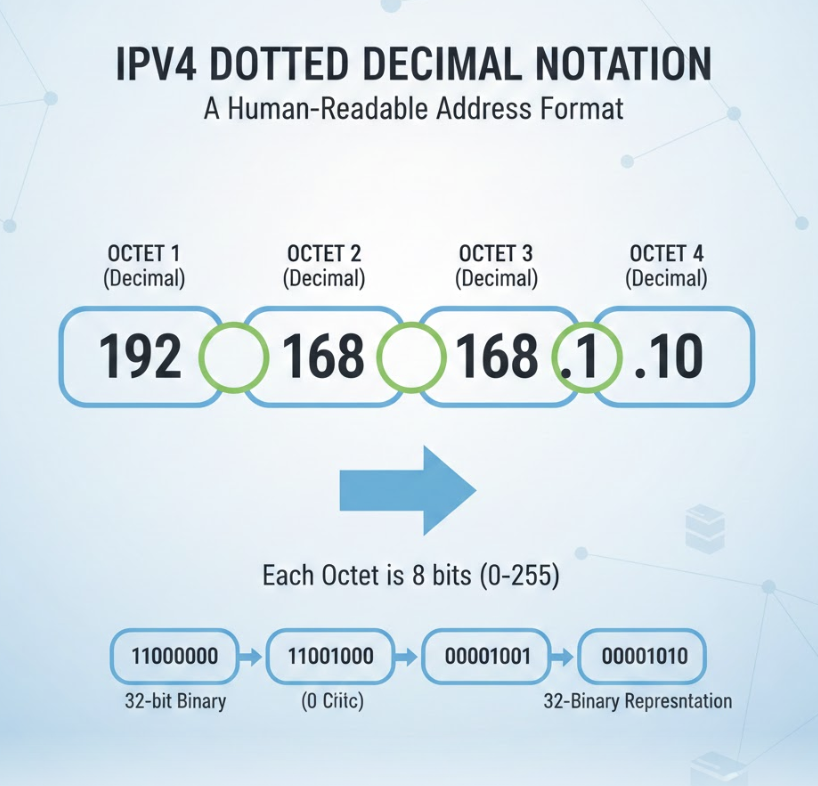
An IPv4 address is typically written as four decimal numbers separated by periods (e.g., 192.168.1.1), with each number ranging from 0 to 255. When you type a website URL into your browser, your device uses the IPv4 address to connect to the server hosting the website.
IPv4 uses a system called “address classes” to manage the allocation of these addresses efficiently. This article explains the different IPv4 address classes—A, B, C, D, and E—and their specific purposes in networking.
There are five main IPv4 address classes: A, B, C, D, and E. Class A, B, and C are used for public and private networks. Class D is reserved for multicast communication. Class E is reserved for experimental purposes. Each class has its unique range and is used for specific purposes, which will be explained in the following sections.
What Are IPv4 Address Classes?
IPv4 is a 32-bit address divided into four octets (e.g., 192.168.1.1).
Early networking divided IPv4 addresses into five classes based on the binary value of the first octet. These classes determined how many networks and hosts a company could have.
There are five IPv4 classes:
- Class A
- Class B
- Class C
- Class D
- Class E
Classes A, B, and C are used for host addressing. Classes D and E are for multicast and research purposes.
1. IPv4 Address Notations
Hexadecimal notation is an alternative way to represent IPv4 addresses, using a base-16 system. Instead of the usual decimal format (base-10), hexadecimal uses 16 digits: 0-9 and A-F.
This format is more compact and efficient for representing long binary strings, but it is less commonly used compared to dotted decimal notation. It provides a concise representation of IP addresses for easier manipulation in network settings.
Classful addressing was an early method to allocate and manage IP addresses based on fixed classes, simplifying IP address distribution. Key advantages include:
- Simplified Routing: Network equipment like routers could easily handle fixed classes, speeding up the routing process.
- Uniform Network Protocols: Classful addressing allowed for standardized address ranges, making network devices compatible across different platforms.
- Cost Effective: It supported early internet expansion by simplifying management, avoiding the complexity of subnetting schemes.
While classful addressing had its limitations, it laid the groundwork for IP address distribution in the early internet days. Check Out | Fixing the “Server IP Address Could Not Be Found” Error
IPv4 address classes define different types of IP address ranges based on the intended use and the size of the network.
2. Class A Addresses
Class A IPv4 addresses are part of the original IP address classification system, designed for networks requiring a substantial number of host addresses.
This class provides a vast address space, allowing for over 16 million hosts within a single network. It is typically used by large organizations, internet service providers (ISPs), and in private network configurations.
| Feature | Details |
|---|---|
| Range | 1.0.0.0 to 127.255.255.255 |
| Purpose | Ideal for large networks with many connected devices |
| Standard Subnet Mask | 255.0.0.0 (or /8) |
| Number of Hosts | More than 16 million host addresses |
| Real-World Use | Used by large companies, government organizations, and universities |
| Example | 10.0.0.0 (often used in private networks) |
3. Class B Addresses
Class B IPv4 addresses are designed for medium to large sized networks that need a moderate number of host addresses. They offer a balance between the address space required for larger networks and the efficiency of address allocation.
Class B addresses are commonly used by universities, large businesses, and some smaller ISPs. The Class B address space is more restrictive than Class A, but it still provides ample room for growth.
| Feature | Details |
|---|---|
| Range | 128.0.0.0 to 191.255.255.255 |
| Purpose | Suitable for medium to large networks |
| Standard Subnet Mask | 255.255.0.0 (or /16) |
| Number of Hosts | More than 65,000 host addresses |
| Real World Use | Used by universities, large organizations, and some internet providers |
| Example | 172.16.0.0 (often used for private networks) |
4. Class C Addresses
IPv4 addresses of Class C are used for smaller networks that need fewer host addresses. This class is ideal for smaller companies or organizations with a limited number of devices connected to their network.
Class C provides a more efficient allocation of IP addresses for networks where large scale expansion is not necessary. Class A, B, and C are used for public and private networks, with Class A supporting the largest networks and Class C the smallest.
(Based on standard IPv4 class definitions, the range for Class C is 192.0.0.0 to 223.255.255.255, with subnet mask 255.255.255.0 (/24), supporting up to 254 hosts per network.)
5. Class D Addresses
Class D IPv4 addresses are reserved for multicast groups, which allow data to be sent to multiple destinations simultaneously. This class is not used for regular network host addresses but is rather employed in specific applications like streaming media, video conferencing, or other group communication services.
| Feature | Details |
|---|---|
| Range | 224.0.0.0 to 239.255.255.255 |
| Purpose | Used for multicast communication to multiple destinations |
| Standard Subnet Mask | Not applicable (multicast addresses don’t require a subnet mask) |
6. Class E Addresses
Class E addresses are reserved for experimental purposes and are not used in standard networking. They are set aside for research and future development, and most routers do not support routing them on the public internet.
(Based on standard IPv4 class definitions, the range for Class E is 240.0.0.0 to 255.255.255.255.)
Special IPv4 Address Ranges You Must Know
| Purpose | Range |
|---|---|
| Private Class A | 10.0.0.0/8 |
| Private Class B | 172.16.0.0 – 172.31.255.255 |
| Private Class C | 192.168.0.0/16 |
| Loopback (Localhost) | 127.0.0.0/8 |
| APIPA | 169.254.0.0/16 |
| Multicast | 224.0.0.0 – 239.255.255.255 |
Why IPv4 Address Classes Matter Today
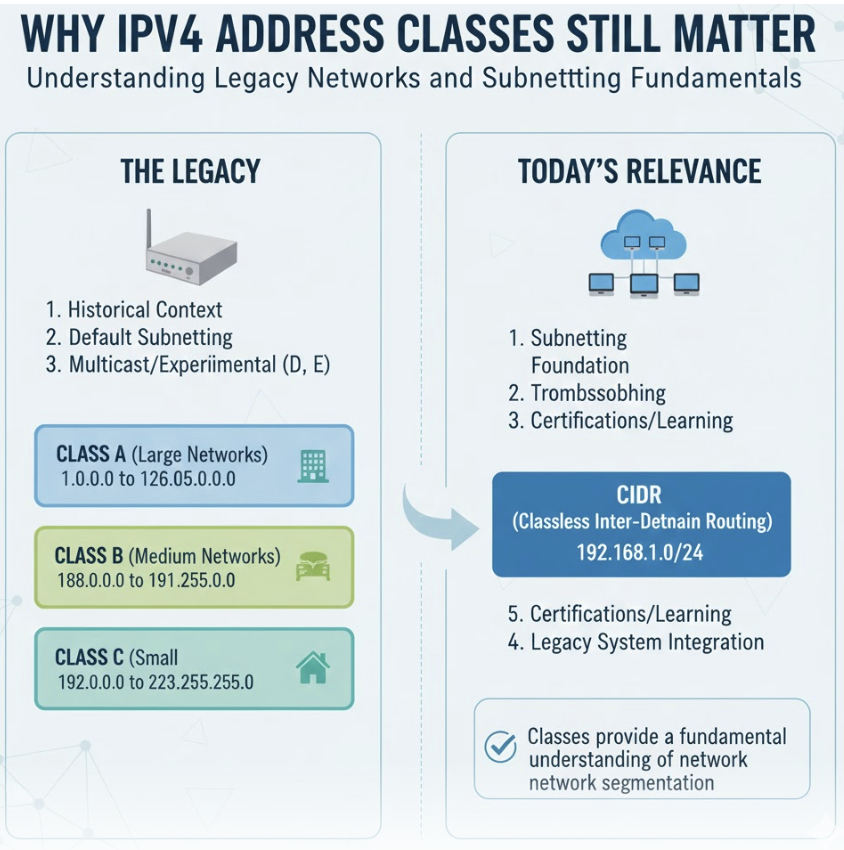
IPv4 address classes—A, B, C, D, and E—serve different purposes depending on the size of the network and the application.
- Subnetting and Network Design: Knowledge of the different classes enables more efficient network segmentation and optimizes address distribution within subnets.
- Network Planning: By understanding address classes, network administrators can select the right range to meet their network’s requirements.
Although classful addressing has largely been replaced by Classless Inter Domain Routing (CIDR) for more flexible allocation, understanding these classes remains fundamental to networking concepts.
Comparison of IPv4 Address Classes
| Class | First Octet | Subnet Mask | Hosts per Network | Purpose |
|---|---|---|---|---|
| A | 1-126 | 255.0.0.0 | 16 million | Very large networks |
| B | 128-191 | 255.255.0.0 | 65k | Medium networks |
| C | 192-223 | 255.255.255.0 | 254 | Small networks |
| D | 224-239 | – | Multicast | Multicast |
| E | 240-255 | – | Experimental | Research |