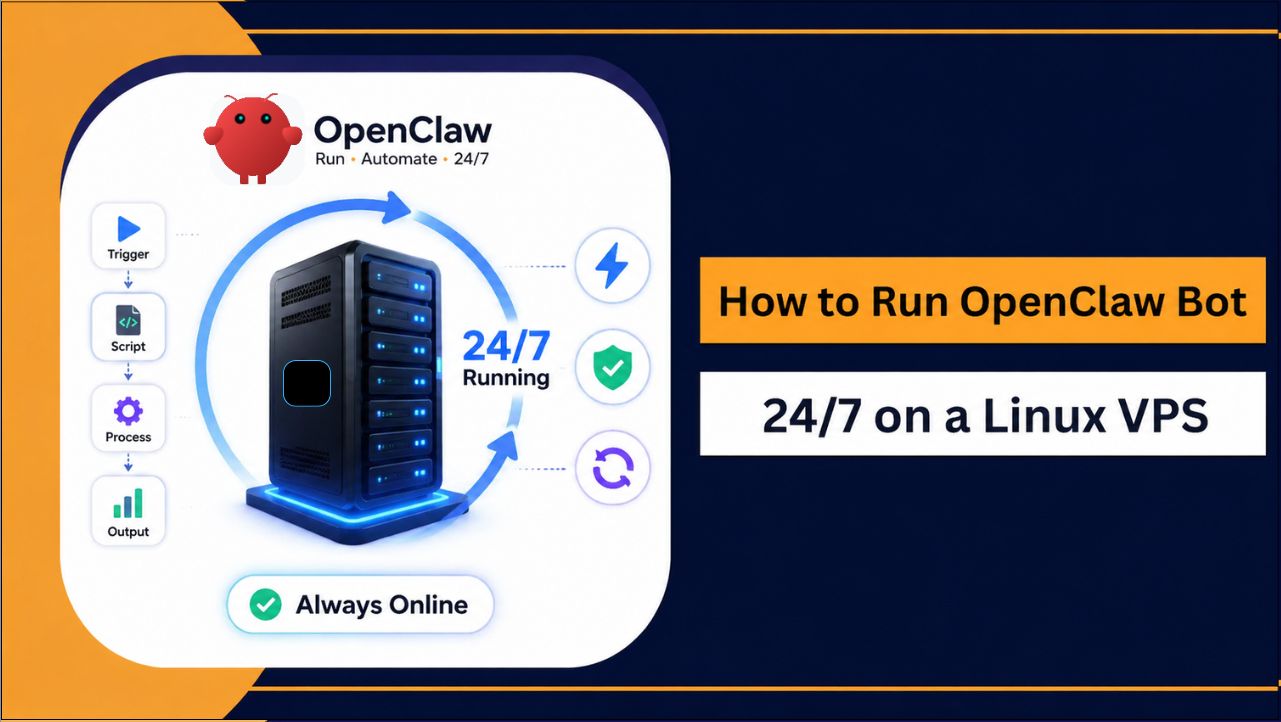
Your OpenClaw bot works perfectly when everything is running smoothly… but the moment your system sleeps, your internet drops, or you disconnect from the terminal, it stops. This is where most people face problems with automation.
In real setups, relying on a personal computer for continuous tasks does not work for long. Even small interruptions can break your workflow, and often you don’t notice it immediately.
A more reliable approach is to use a Linux VPS, where your bot runs independently in a stable environment without depending on your device.
This guide explains how to run OpenClaw bot 24/7 on a Linux VPS with a clear step-by-step process, based on practical setup experience, so your automation keeps working without interruptions.
What Is OpenClaw Bot?
OpenClaw is an automation based bot system built to run tasks continuously without manual input. It can be configured for workflows like automation scripts, monitoring, data processing, or AI driven operations.
It is commonly used when tasks need to run repeatedly without interruption. Instead of handling everything manually, the bot manages processes in the background in a structured and efficient way.
- It automates repetitive tasks, which saves time and reduces manual effort
- It runs continuously in the background, so uptime and stability become very important
The main advantage of OpenClaw is consistency. It performs tasks reliably, which is why running it in a stable environment like a VPS becomes important for long term use.
Why You Need a Linux VPS to Run OpenClaw 24/7
If you’ve already tried running OpenClaw on your own system, you’ve probably noticed one thing very quickly, it only works reliably when everything stays perfect. The moment your laptop goes into sleep mode, your internet connection becomes unstable, or you disconnect from the terminal, the bot stops running.
Here’s what usually happens in real world usage:
- Your system needs to stay powered on all the time, which is difficult to maintain long term
- Even a short internet interruption can stop the bot completely
- Background processes may crash silently without immediate notice
- System updates or unexpected restarts can interrupt workflows without warning
After moving the same OpenClaw setup to a Linux VPS, the difference becomes immediately noticeable.
A VPS is designed for continuous uptime, which completely changes how OpenClaw performs in long running environments:
- Consistent 24/7 uptime: Your bot continues running even when your personal device is offline
- Access from anywhere: You can manage and monitor your setup remotely using SSH
- Stable environment: No sleep mode interruptions, local system conflicts, or random shutdowns
- Flexible scalability: CPU, RAM, and storage can be upgraded easily as workloads increase
In practical usage, this is why most automation focused users eventually shift to a VPS based setup.
Many users also prefer a Docker based OpenClaw setup because it improves deployment stability and reduces dependency related issues on Linux VPS environments.
System Requirements for Running OpenClaw Bot
Before setting up OpenClaw on a VPS, it’s worth getting the configuration right from the beginning. I’ve tested this on both low end and mid range servers, and while OpenClaw can run on minimal resources, performance and stability improve a lot when you give it a bit more headroom.
Here’s what actually works in real scenarios:
Minimum Requirements (For Basic Usage & Testing)
If you’re just starting out or running lightweight automation:
- 1 vCPU
- 1 GB RAM
- 20 GB SSD storage
This setup will run OpenClaw, but you may notice slowdowns if your bot handles multiple tasks or heavier workloads. It’s fine for learning and small scale usage.
Recommended Setup (For Stable 24/7 Performance)
From experience, this is where things start feeling smooth and reliable:
- 2 vCPU
- 2–4 GB RAM
- NVMe storage (faster than standard SSD)
With this configuration, the bot runs consistently without random lag or memory related crashes, even when tasks scale slightly.
Operating System (What Works Best in Practice)
- Ubuntu 22.04 LTS – This is the most stable and widely supported option. Most guides, libraries, and dependencies work seamlessly here.
- Debian 11/12 – A solid alternative if you prefer a more lightweight and minimal setup.
In real use, Ubuntu tends to save time because of better community support and fewer compatibility issues.
Required Tools (Essential Setup)
Make sure your VPS includes or supports:
- SSH access – This is how you’ll connect and manage your server remotely
- Git – Needed to download or update your OpenClaw bot files
- Python or Node.js – Depends on how your OpenClaw bot is built
One thing I’ve learned from experience: always verify versions after installation. Many setup issues come from outdated or incompatible versions rather than the bot itself.
Getting these basics right from the start avoids most common problems later. A slightly better VPS plan often saves hours of troubleshooting and gives you a much smoother 24/7 setup.
Choosing the Right Linux VPS Provider
This is one area where most people go wrong in the beginning. On paper, almost every VPS provider looks similar, with close pricing and nearly identical specs. But in real usage, the difference becomes obvious very quickly.
I have tested OpenClaw on both low cost and mid range VPS providers, and the biggest issue was not raw speed. The real problem was stability. Random downtime, slow disk response, and network interruptions can quietly break your bot even when everything is set up correctly.
Here is what actually matters when choosing a VPS:
What to Look For
- Consistent uptime (99.9% or higher): Even short downtime can interrupt automation tasks. A reliable provider keeps your server running without frequent outages.
- SSD or NVMe storage: NVMe storage gives noticeably faster performance. Tasks execute quicker, installations finish faster, and the overall system feels smoother.
- Server location (GEO relevance): Choose a data center close to your target region. Lower latency helps when your bot connects to APIs or external services.
- Scalability: As your OpenClaw workload increases, you should be able to upgrade CPU or RAM easily without rebuilding everything.
What to Avoid (Based on Real Usage)
- Very cheap VPS plans with unrealistic pricing
- Providers with unstable network connections
- Oversold servers where too many users share the same resources
These setups may work at first, but after some time you start noticing issues like lag, unexpected restarts, or downtime.
What Actually Works
A balanced VPS plan usually gives the best results. It does not have to be the most expensive option, but it should be reliable. Once you run OpenClaw on a stable server for a few days without interruptions, the difference becomes very clear.
Choosing the right provider is not just about specifications. It directly affects whether your bot runs smoothly or keeps failing without obvious reasons.
Step-by-Step Guide to Run OpenClaw Bot on Linux VPS
This is the exact setup process I’ve personally used multiple times. If you follow each step carefully, your OpenClaw bot will run without issues. Most errors people face usually come from skipping small details, so take it step by step.
Step 1: Connect to Your VPS via SSH
Once you purchase a VPS, you’ll receive your server IP, username, and password.
Open your terminal and connect using:
ssh root@your_server_ipThe first time you connect, it may ask for confirmation. Type yes, then enter your password.
From experience, if SSH does not connect, it is usually due to a wrong IP or blocked port. Always double check your credentials.
Step 2: Update Your Server
Before installing anything, update your system. This avoids compatibility issues later.
apt update && apt upgrade -yI always do this step first because outdated packages often cause dependency errors during installation.
Step 3: Install Required Dependencies
Now install the basic tools required to run OpenClaw:
apt install git python3 python3-pip -yVerify installation:
python3 --version
git --version
If versions do not show correctly, reinstall before moving forward. Many setup issues start here.
Step 4: Download OpenClaw Bot
Clone your OpenClaw repository:
git clone https://github.com/your-repo/openclaw.git
cd openclaw
If your bot files are on your local system, you can upload them using SCP or any SFTP client.
In real setups, I prefer Git because it makes updates easier later.
Step 5: Configure the Bot
This is one of the most important steps. Most errors happen here.
You will typically need to:
- Add API keys
- Set environment variables
- Configure settings inside files
Open your config file:
nano .envMake sure every required value is filled correctly. Even a small mistake in API keys or variables can prevent the bot from starting.
Step 6: Install Project Dependencies
Install all required Python packages:
pip3 install -r requirements.txtIf you see errors, read them carefully. In most cases, missing libraries or version mismatches are the cause. Fix them before continuing.
Step 7: Run the OpenClaw Bot
Now start your bot:
python3 main.pyIf everything is set up correctly, the bot should start running without errors.
When I first tested this setup, I always watched the logs for a few minutes to confirm everything was working properly. This simple check helps catch issues early.
Following this process exactly gives you a clean and stable setup. Once your bot runs successfully here, the next step is making sure it stays running 24/7 without interruption.
How to Keep OpenClaw Running 24/7
Starting the bot is only half the work. The real challenge is keeping it running even after you disconnect from SSH or if something crashes in the background.
When I first ran OpenClaw on a VPS, I made the mistake of just starting it in the terminal. The moment I closed the session, the bot stopped. That’s a common issue, and the fix is to use proper session managers or process managers.
Here are the methods that actually work in real usage:
Method 1: Using Screen
This is the simplest way to keep your bot running in the background.
Install screen:
apt install screenStart a new session:
screen -S openclawRun your bot:
python3 main.pyNow detach from the session without stopping the bot:
Press
Ctrl + A, then press D
Your bot will keep running in the background.
To reconnect later:
screen -r openclawThis method works well for beginners and quick setups.
Method 2: Using TMUX
TMUX is similar to screen but gives more control and flexibility.
Install tmux:
apt install tmuxStart a session:
tmuxRun your bot:
python3 main.pyDetach from session:
Press
Ctrl + B, then press D
To reattach:
tmux attachFrom my experience, TMUX is more stable when managing multiple sessions, but for a single bot, both options work fine.
Method 3: Using PM2 (Recommended for Long Term Use)
If you want a proper 24/7 setup, PM2 is the best option. This is what I use for long running bots because it handles crashes automatically.
Install PM2:
npm install pm2 -gStart your bot:
pm2 start main.py --name openclawSave the process:
pm2 saveEnable startup on reboot:
pm2 startupPM2 will:
- Restart your bot automatically if it crashes
- Keep it running after server reboot
- Allow you to monitor logs easily
You can check status anytime:
pm2 listWhat Actually Works Best
If you are just testing, screen or tmux is enough.
But for a real 24/7 setup, PM2 is the most reliable option. Once I switched to PM2, I stopped worrying about crashes or disconnections because the bot simply restarts on its own.
This is the setup most serious users rely on when they want true continuous automation.
How to Auto Start OpenClaw Bot After VPS Reboot
One thing many people realize a bit late is this: even if your bot is running perfectly, a simple VPS reboot will stop everything unless you’ve configured auto start.
I’ve faced this myself during scheduled server updates. The VPS restarted, and the bot stayed offline for hours because there was no startup setup. That’s why this step is essential if you want true 24/7 automation.
Using PM2 for Auto Start (Most Reliable Method)
If you’re already using PM2, enabling auto start takes just a few commands.
First, save your current running process:
pm2 saveThen generate and enable startup script:
pm2 startupAfter running this, PM2 will show a command. Copy and execute that command exactly as shown. This step links PM2 with your system’s startup process.
How It Works in Practice
Once configured:
- Your bot starts automatically whenever the VPS reboots
- No need to manually log in and restart it
- Downtime is minimized even after unexpected restarts
From my experience, this small setup makes a huge difference. After enabling auto start, you don’t have to worry about your bot going offline silently.
Quick Verification
After setup, you can test it:
- Reboot your VPS
- Log back in
- Check status:
pm2 listIf your OpenClaw bot shows as online, everything is configured correctly.
This step completes your 24/7 setup. Without auto start, your system is not truly automated. Once this is in place, your OpenClaw bot runs continuously without manual intervention.
Security Best Practices
Keeping your VPS secure is essential:
- Change default SSH port
- Disable root login (optional but recommended)
- Use SSH keys instead of passwords
- Enable firewall:
ufw allow OpenSSH
ufw enable
Common Problems and Fixes
Even after setting everything correctly, a few issues can still appear when running OpenClaw on a VPS. I’ve faced most of these during real setups, and in many cases, the problem is small but not obvious at first.
Here are the most common issues and how to fix them:
Bot Stops Automatically
This is one of the most frequent problems.
Why it happens:
- SSH session gets disconnected
- Script crashes silently
- No process manager is used
Fix:
- Use PM2 instead of running directly in terminal
- Start your bot with:
pm2 start main.py --name openclawFrom experience, once I switched to PM2, random stopping issues were almost completely gone.
Bot Stops After VPS Reboot
Many people miss this step.
Why it happens:
- Auto start is not configured
Fix:
pm2 save
pm2 startup
After this, your bot will restart automatically whenever the server reboots.
Module or Dependency Errors
You may see errors like:
- Module not found
- Import errors
Why it happens:
- Missing libraries
- Incorrect Python version
Fix:
pip3 install -r requirements.txtIf the issue continues, check your Python version:
python3 --versionIn real setups, version mismatch is one of the most common hidden problems.
Permission Denied Errors
This usually happens when files or scripts don’t have proper permissions.
Fix:
chmod +x main.pyOr run with correct user permissions. Avoid mixing root and non-root setups unnecessarily.
High CPU or RAM Usage
If your VPS becomes slow or your bot crashes:
Why it happens:
- Low RAM
- Heavy tasks
- Memory leaks
Fix:
- Upgrade your VPS plan
- Monitor usage:
htopFrom my testing, 1 GB RAM works for basic tasks, but 2 GB or more gives much better stability.
Bot Not Connecting to APIs
Sometimes the bot runs but doesn’t perform actions.
Why it happens:
- Wrong API keys
- Network restrictions
- Firewall issues
Fix:
- Recheck your .env file
- Verify API keys
- Ensure ports are open
Even a small typo in API keys can stop the bot completely.
Port or Firewall Issues
If your bot depends on network communication:
Fix:
ufw allow OpenSSH
ufw allow 3000   # example port
ufw enable
Make sure required ports are open.
Logs Not Showing or Hard to Debug
When something goes wrong, logs are your best friend.
Fix (PM2):
pm2 logs openclawThis helps you quickly identify what is breaking.
What Actually Helps in Real Usage
From experience, most problems come down to:
- Missing dependencies
- Incorrect configuration
- Not using a process manager
Once you set up PM2, verify configs carefully, and monitor logs, OpenClaw becomes very stable and runs without interruptions.
Fixing these small issues early saves a lot of time later and makes your 24/7 setup truly reliable.
Performance Optimization Tips
Once your OpenClaw bot is running 24/7, the next step is making sure it runs smoothly and efficiently over time. In real usage, performance issues don’t usually appear immediately. They build up slowly, especially when your bot runs continuously for hours or days.
I’ve seen setups that worked fine at the beginning but started lagging later because optimization was ignored. These small improvements make a big difference in long term stability.
Monitor Resource Usage Regularly
Before optimizing anything, first understand how your bot is using resources.
Use:
htopCheck:
- CPU usage
- RAM consumption
- Background processes
In my testing, memory usage creeping up over time is a common sign that something needs adjustment.
Choose the Right VPS Plan
If your VPS is underpowered, no amount of optimization will fully fix performance issues.
- 1 GB RAM works for basic tasks
- 2–4 GB RAM gives much better stability
- NVMe storage improves overall responsiveness
I’ve noticed that upgrading from 1 GB to 2 GB RAM alone can remove random slowdowns completely.
Use a Process Manager (PM2)
Running your bot directly is not efficient for long term usage.
PM2 helps by:
- Restarting the bot if it crashes
- Managing memory usage
- Keeping logs organized
You can monitor performance with:
pm2 monitThis gives a live view of CPU and RAM usage.
Optimize Your Bot Scripts
Sometimes the issue is not the server but the bot itself.
Check for:
- Unnecessary loops
- Frequent API calls
- Unoptimized logic
Even small improvements in your script can reduce CPU usage significantly.
Reduce Unnecessary Background Services
Many VPS setups run services you don’t actually need.
Disable unused services to free up resources:
systemctl list-unit-files --type=serviceStop unnecessary ones to reduce load.
Keep Your System Clean
Over time, unused packages and logs can build up.
Clean your system:
apt autoremove -y
apt clean
This helps maintain consistent performance.
Use Lightweight OS Setup
If performance is important, avoid heavy environments.
- Stick with minimal Ubuntu or Debian
- Avoid installing GUI on VPS
A clean system always performs better in long term usage.
Manage Logs Properly
Logs can grow large and consume disk space.
With PM2:
pm2 flushThis clears old logs and keeps your system clean.
What Actually Makes the Biggest Difference
From real experience, these three things improve performance the most:
- Using enough RAM (at least 2 GB for stability)
- Running the bot with PM2
- Monitoring usage regularly
Once these are in place, OpenClaw runs smoothly without random slowdowns or crashes.
Optimizing performance is not about making everything perfect at once. It’s about keeping your setup stable over time so your bot continues running efficiently without interruptions.
When You Should Use a VPS for OpenClaw
Not every OpenClaw setup requires a VPS. In the beginning, I also ran everything locally just to test things quickly. But as soon as the workload became consistent, the limitations started showing.
Here’s when moving to a VPS actually makes sense based on real usage:
When You Want True 24/7 Automation
If your bot is supposed to run continuously without stopping, a VPS is the only practical option.
On a local system:
- Your device can shut down
- Internet can disconnect
- Sessions can close
On a VPS:
- Your bot runs independently
- No dependency on your personal system
This is usually the first reason people switch.
When Your Tasks Are Time Sensitive
If your OpenClaw bot handles tasks like:
- Monitoring
- Scheduled automation
- API based operations
Even a few minutes of downtime can affect results.
A VPS keeps your bot active continuously, which is important for time based workflows.
When You Want Stability and Reliability
Local setups are unpredictable. Background apps, system updates, or even power issues can stop your bot.
With a VPS:
- The environment stays consistent
- No unexpected interruptions
- Long running tasks complete without issues
When You Are Scaling Your Workload
As your bot grows, it starts using more:
- CPU
- RAM
- Network requests
A VPS allows you to upgrade resources easily without changing your setup.
When You Want Remote Access and Control
With a VPS, you can manage your bot from anywhere using SSH.
This means:
- You are not tied to one device
- You can monitor and fix issues anytime
When You Are Running Business or Critical Tasks
If your automation is connected to:
- Client projects
- Data processing
- Revenue related tasks
Then stability becomes essential.
Where to Get a Reliable VPS for OpenClaw
If you are planning to move your OpenClaw bot to a VPS, choosing the right provider makes a big difference in long term stability.
A practical option is YouStable, especially if you want a setup that works smoothly without constant troubleshooting.
You can explore their optimized plans here: OpenClaw VPS Hosting
These plans are suitable for:
- Running bots continuously without interruptions
- Getting fast performance with NVMe storage
- Scaling resources easily as your workload grows
What It Feels Like in Real Use
Once you shift OpenClaw to a VPS, the setup feels completely different. You no longer have to worry about whether your system is on or whether your bot is still running.
It becomes a stable background system that keeps working continuously.
Simple Rule
If your OpenClaw bot is important enough that it should not stop, then using a VPS is the right decision.
And if you want a straightforward and reliable setup without wasting time on unstable servers, choosing a provider like YouStable is a practical approach.
FAQs
Can I run OpenClaw bot without a VPS?
u003cstrongu003eYesu003c/strongu003e, you can run OpenClaw on your local system, but it will only work while your device is powered on and connected to the internet. For continuous 24/7 operation, a VPS is the more reliable option.
Which VPS configuration is best for OpenClaw?
For stable performance, a VPS with at least u003cstrongu003e2 vCPU and 2–4 GB RAMu003c/strongu003e is recommended. NVMe storage also improves speed and responsiveness, especially for long running automation tasks.
Why does my OpenClaw bot stop after I disconnect SSH?
This happens because the bot is running in your active terminal session. When the session closes, the process stops. Using tools like u003cstrongu003ePM2, Screen, or TMUXu003c/strongu003e keeps your bot running in the background.
What happens if my VPS restarts?
If auto start is not configured, your bot will stop after a reboot. Setting up u003cstrongu003ePM2 startup and save commandsu003c/strongu003e ensures your OpenClaw bot starts automatically whenever the server restarts.
What are the basic requirements to run OpenClaw smoothly on a VPS?
For a stable and smooth setup, make sure your VPS has:u003cbru003eu003cstrongu003e• u003c/strongu003eAt least u003cstrongu003e2 vCPUu003c/strongu003e for better processingu003cbru003eu003cstrongu003e• 2–4 GB RAMu003c/strongu003e for stable performanceu003cbru003eu003cstrongu003e• NVMe or SSD storageu003c/strongu003e for faster executionu003cbru003eu003cstrongu003e• u003c/strongu003eA lightweight OS like u003cstrongu003eUbuntu or Debianu003c/strongu003eu003cbru003eu003cstrongu003e• u003c/strongu003eProper setup with u003cstrongu003ePM2 for auto restart and monitoringu003c/strongu003eu003cbru003eThese requirements help avoid common issues like crashes, slow performance, or unexpected downtime.
Conclusion
Running OpenClaw on a Linux VPS changes how your automation performs in real conditions. Instead of depending on your personal system, you get a stable environment where your bot keeps working continuously without interruptions.
After setting up everything properly and using tools like PM2 with auto start, the entire system becomes reliable. Your bot no longer stops because of system shutdowns, internet issues, or disconnected sessions.
From practical experience, this setup not only improves uptime but also reduces the time spent fixing unexpected problems. Once everything is configured correctly, it simply runs in the background without constant monitoring.
If your goal is to keep OpenClaw running smoothly and consistently, moving to a VPS is the most effective approach. And with a stable provider, the overall experience becomes much easier and more dependable.