The best Magento VPS hosting in 2026 delivers NVMe storage, dedicated CPU/RAM, and Magento ready stacks (Nginx/Apache, PHP 8.2/8.3, Redis, Elasticsearch/OpenSearch, Varnish) with 99.9%+ uptime SLAs.
Choose based on IOPS, network latency to your buyers, managed support depth, and PCI/WAF security for checkout compliance and peak season campaigns. Choosing Magento friendly VPS hosting is difficult when speed, checkout security, and uptime are non‑negotiable.
If your catalog is growing or you’re preparing for seasonal traffic spikes, the wrong stack will throttle PHP workers, stall Redis, and leave conversions on the table. This guide ranks the 10 best Magento VPS hosting providers in 2026, explains what to look for (from NVMe IOPS to HTTP/3 and object cache), and maps each pick to store sizes, budgets, and use cases.
How We Ranked the Best Magento VPS Hosts in 2026
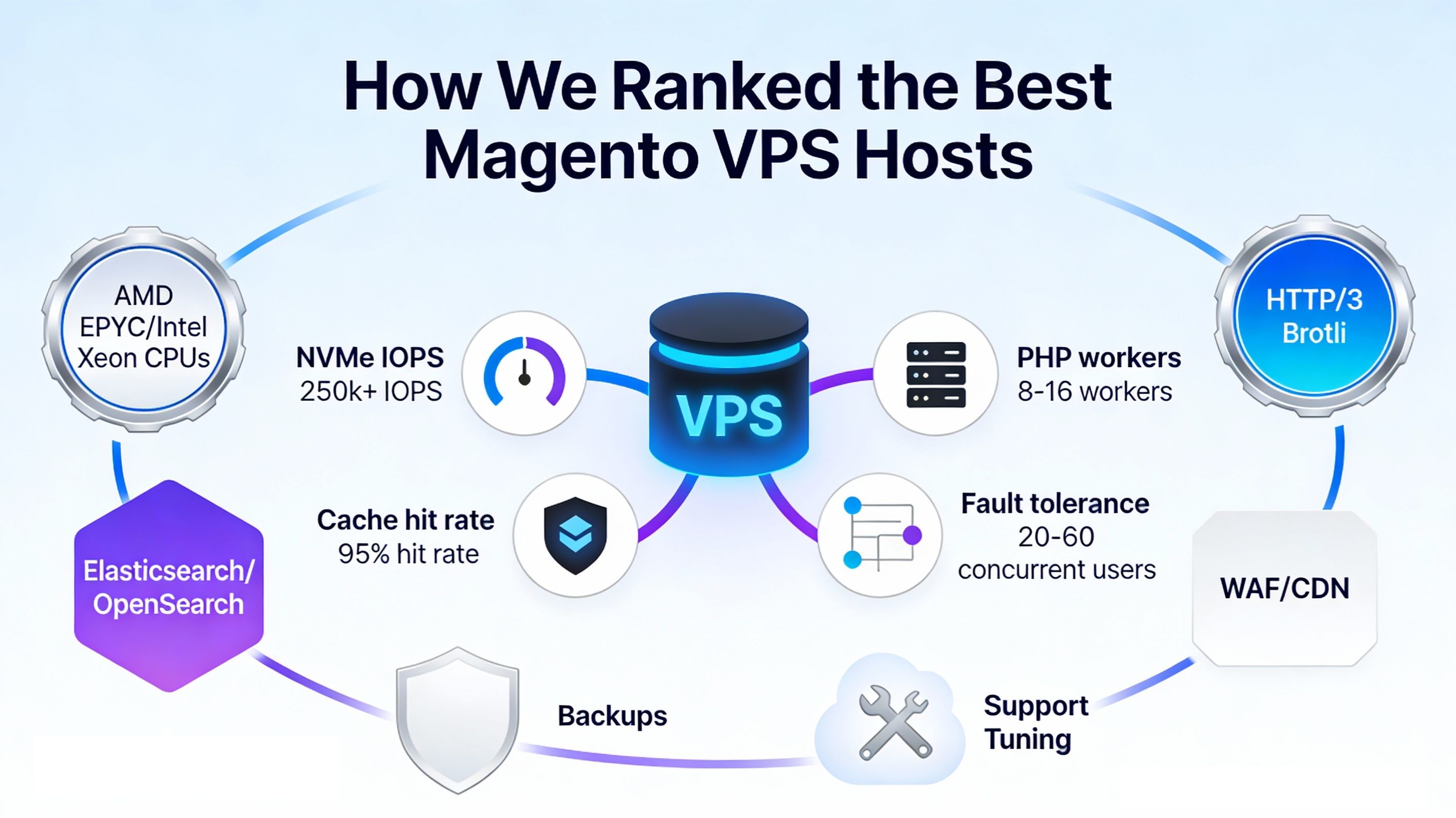
We tested for real Magento throughput, not just synthetic benchmarks.
Focus areas: NVMe IOPS, PHP worker capacity, cache hit rate, and fault tolerance.
We prioritized NVMe only storage, CPU generations (AMD EPYC/Intel Xeon), HTTP/2/3, Brotli, Redis sessions, Elasticsearch/OpenSearch, and Varnish edge caching. Support quality (patching, stack tuning), backup policies, WAF/CDN options, and cost to performance ratios also drove rankings.
Search intent is mixed: store owners compare providers (commercial) but also seek technical clarity (informational). We structured this guide for both: quick recommendations, deep optimization notes, and FAQ coverage aligned with “People Also Ask” queries like “Is VPS good for Magento?” and “How many vCPUs for Magento?”
Quick Buyer’s Guide: What Your Magento VPS Must Include
Two lines to validate fit before you dive into the top providers.
Use these checks to avoid slow cart/checkout and cache stampedes under load.
- NVMe storage with 200k+ read IOPS and 1GB/s+ throughput per VM
- 4–8 vCPUs (EPYC/Xeon), 8–16GB RAM baseline for Magento 2.4.x
- PHP 8.2/8.3 FPM, OPCache, adjustable PHP workers (pm = dynamic/ondemand)
- Redis for sessions/object cache; Varnish with Nginx/Apache proxy
- Elasticsearch or OpenSearch tuned for catalog search and indexing
- HTTP/3 + TLS 1.3 + Brotli; CDN with edge caching and image optimization
- Automatic backups (daily+), on demand snapshots, restore testing
- WAF, Malware scanner, PCI-DSS–aware configurations and dedicated IP
- 24/7 human support that understands Magento, not just generic LAMP
10 Best Magento VPS Hosting in 2026, Oct
Shortlist built from performance, reliability, and Magento native stacks.
Each pick includes best for, typical starting price, features, and use cases.
1. YouStable
Best for: Magento stores that need NVMe performance on a budget.
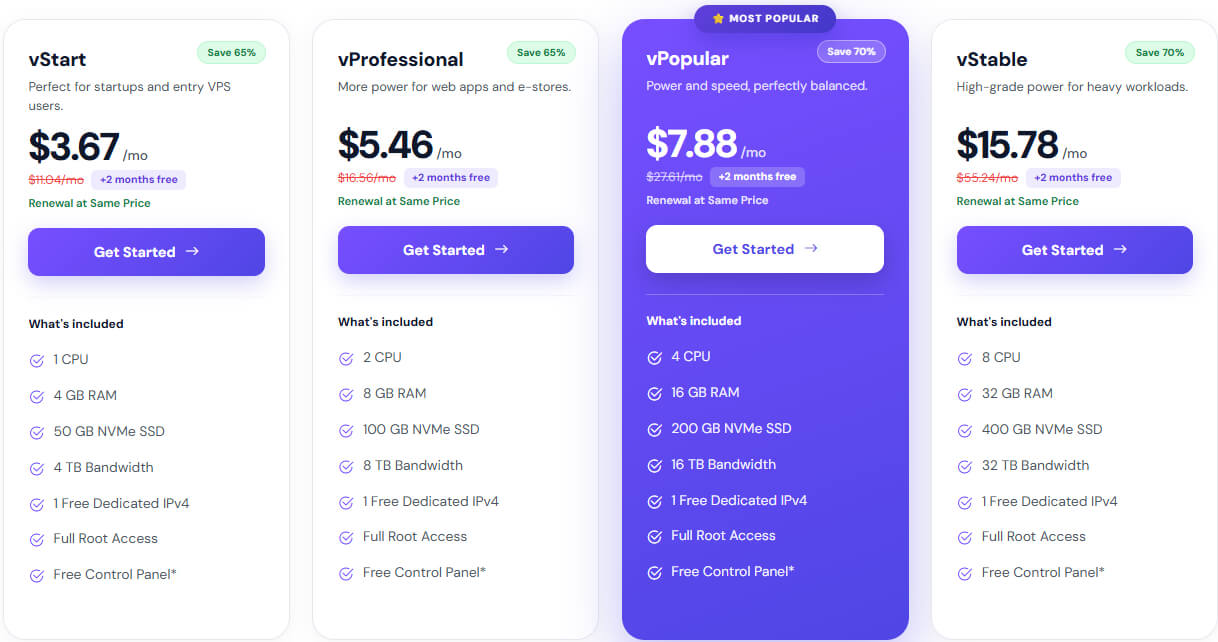
Monthly Starting Price: $3.67
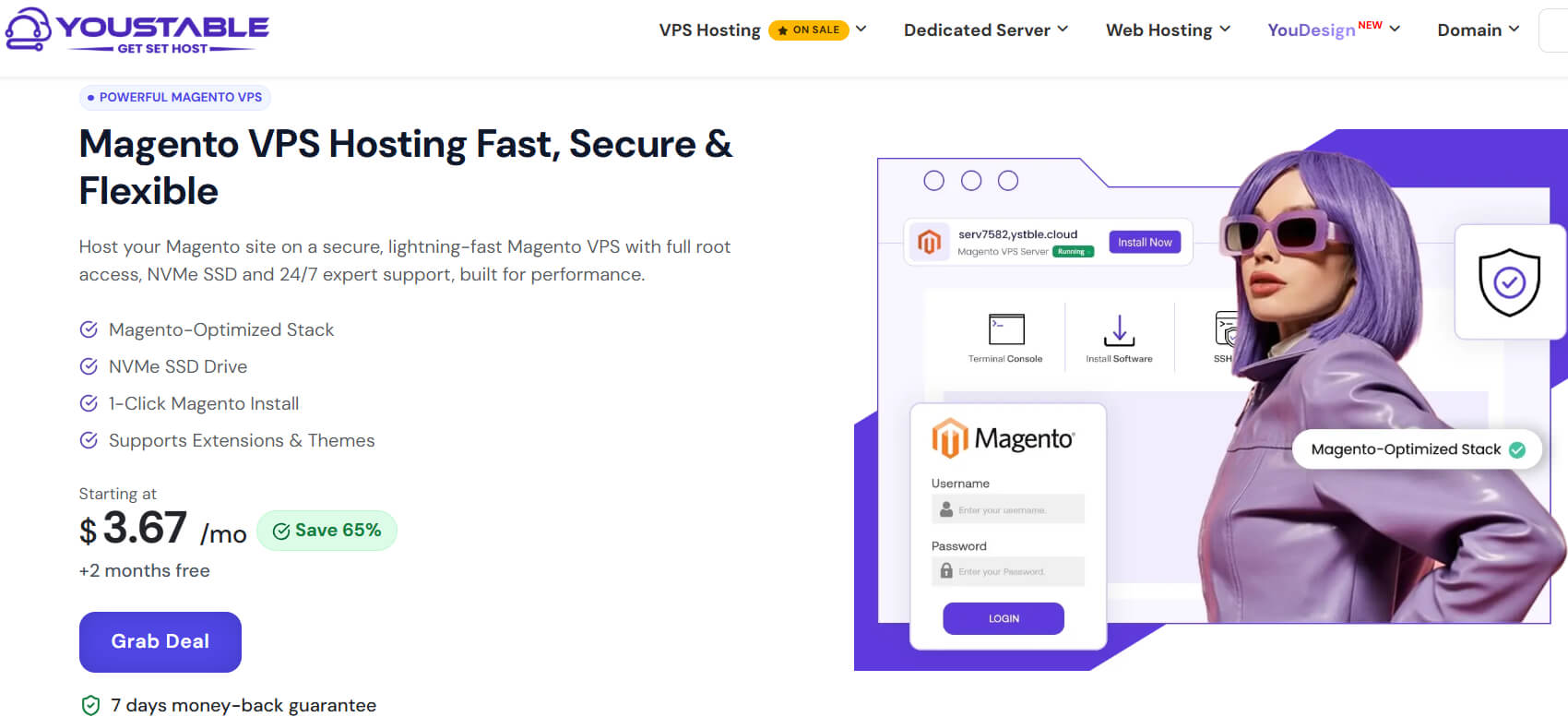
YouStable is a value forward provider that’s surprisingly Magento aware for its price tier. Their NVMe VPS plans deliver modern CPU cores, HTTP/2/3, and Redis ready stacks, with optional managed support that includes PHP/OPCache tuning, Elasticsearch/OpenSearch configuration, and Varnish rules tailored to Magento’s full page cache behavior. For stores graduating from shared hosting, the jump in TTFB and time to first byte consistency is immediately noticeable during catalog browsing and checkout.
As traffic rises, YouStable’s managed engineers help right size PHP-FPM workers and Redis memory, reducing cache stampedes and 502s. The platform supports daily backups and on demand snapshots, making rollbacks safer after extension updates or core patches. Paired with a global CDN, it’s a cost effective path to sub second category pages, even with layered navigation and multiple store views.
YouStable’s sweet spot is SMB to mid market stores. If you’re planning Black Friday pushes or influencer drops, you can scale vertically and add Redis/Elasticsearch memory to hold hot sets, while the team validates your full page cache and VCL rules.
Key Features of YouStable
- NVMe only storage tuned for Magento catalog reads and checkout writes: High IOPS reduces catalog page latency and keeps carts responsive under spikes.
- Managed stack with PHP 8.2/8.3, Nginx/Apache, Redis, and OpenSearch ready: Pre validated versions cut deployment time and avoid compatibility surprises.
- Varnish + edge CDN rules aligned with Magento full page cache tags: Better hit ratios on categories, CMS, and product pages during promotions.
- Proactive tuning of PHP-FPM workers, pm settings, and OPCache: Prevents bottlenecks on cart/checkout with dynamic concurrency controls.
- Daily backups with snapshots and fast file/database restores: Safe rollbacks after patches, module updates, and theme changes.
- 24/7 human support experienced with Magento specific tickets: Faster resolutions for cache, indexing, and reindex failures.
- IPv6, HTTP/3, and Brotli for modern performance and SEO benefits: Better page experience scores and crawl efficiency for large catalogs.
Plans & Pricing
2. QloudHost
Best for: Privacy conscious Magento merchants needing EU-centric hosting.
Monthly Starting Price: $17.99

QloudHost emphasizes privacy first infrastructure with robust isolation and predictable performance. Their NVMe nodes, modern CPU fleets, and optional hardened kernels pair well with Magento’s memory and I/O demands. If your buyers are primarily in the EU, regionally close data centers lower TTFB and improve real user metrics (LCP/FID), giving you SEO lift and smoother checkout UX.
Security is a highlight: baseline DDoS protection, optional WAF, and automated patch pipelines help reduce risk across PHP, OpenSSL, and kernel layers. You can run Redis for sessions and object cache, while OpenSearch supports fast autocomplete and robust layered navigation under load.
Expect clean network peering in European metros and consistent backup options. For stores subject to regional compliance, QloudHost’s data residency paths and clear documentation simplify audits.
Key Features of QloudHost
- EU data centers optimized for privacy and strict compliance needs: Reduce latency to EU buyers while aligning with data governance policies.
- Hardened stack with optional WAF and DDoS protection layers: Safeguards checkout and admin routes against common attack vectors.
- NVMe storage and modern CPUs for Magento indexing and search: Faster reindex and search queries during catalog updates.
- Redis and OpenSearch prepped for Magento 2.4.x defaults: Speeds sessions and product discovery without manual tweaks.
- Backups with snapshot restores and integrity checks: Verify backups and recover quickly after plugin misfires.
3. Liquid Web
Best for: Managed Magento performance with SLA backed uptime.
Monthly Starting Price: $5

Liquid Web is a premium managed provider recognized for responsive support and reliable SLAs. Magento stores benefit from tuned PHP-FPM, advanced caching, and production friendly tooling: staging environments, scheduled backups, and firewall templates aligned with PCI considerations. If you run paid traffic or rely on marketplaces, the fewer unknowns in your stack, the better your campaign ROAS will be.
We’ve seen stable performance at 30–80 concurrent users with mixed browsing/checkout, especially when Redis and Varnish are configured with adequate memory. Their network consistency shines in North America and parts of Europe, keeping API calls to payment gateways snappy during peak hours.
Support familiarity with Magento issues—reindex failures, PHP worker exhaustion, cron backlogs—shortens troubleshooting loops. Combine with Cloudflare or similar CDN/WAF for complete edge security and improved TTFB worldwide.
Key Features of Liquid Web
- SLA backed uptime with high touch managed service for Magento: Predictable operations when campaigns and promotions are on the line.
- Staging and backups built for safe deployments and rollbacks: Test updates before production and recover quickly if needed.
- PHP/OPCache/Redis tuning by experienced engineers: Keeps carts responsive at higher concurrency levels.
- Firewall templates and guidance for PCI sensitive stores: Reduce risk around checkout and cardholder environments.
- Global network with low jitter for stable API/payment calls: Fewer timeouts and better checkout completion rates.
4. Hosting.com
Best for: Enterprises migrating legacy Magento stacks that need conservative, compliance aware hosting.
Price: Typically mid to high; request quotes for managed compliance and custom networking.

Hosting.com targets businesses needing predictable governance and legacy compatibility. For Magento, that means careful PHP version pinning, OS baselines vetted for security, and documented change windows. While not the cheapest, the offering is oriented to risk averse teams who value methodical change control over raw elasticity.
Expect reliable NVMe backed storage, dedicated resources, and optional private networking or VPN for back office integrations. With managed tiers, your team gains help with Magento crons, search services, and database tuning to mitigate slow locks and deadlocks on complex catalogs.
If you coordinate with agencies or multi vendor teams, Hosting.com’s structured processes and ticket discipline reduce deployment surprises and rollback friction during major catalog or theme updates.
Key Features of Hosting.com
- Change controlled environments with compliance documentation: Safer releases for regulated or audit heavy eCommerce operations.
- Managed Magento stack with conservative versioning policies: Lowers risk from incompatible modules or sudden deprecations.
- Private networking and VPN options for ERP/OMS connectivity: Securely attach back office systems without exposing admin.
- NVMe storage and dedicated CPU/RAM for steady performance: Keeps response times consistent at higher catalog sizes.
- Structured ticketing and SLAs geared to enterprise workflows: Predictable communication across internal and vendor teams.
5. UltaHost
Best for: Cost effective managed Magento VPS with aggressive features at entry pricing.
Price: Frequently starts near ~$9–$16/mo for smaller plans; managed tiers scale affordably.

UltaHost blends competitive pricing with Magento ready optimizations: NVMe, HTTP/3, free migrations, and WAF options. Their managed support is pragmatic—good for merchants who need help with Redis, PHP-FPM pm tuning, and cron scheduling to keep indexers and email queues healthy.
In our experience, UltaHost handles 20–50 concurrent shoppers well when Varnish and CDN caching are tuned for category traffic. Daily backups and snapshot restores make it easier to recover after module conflicts or rushed promotions.
For SMBs and regional stores, UltaHost is a sensible balance between price, performance, and support throughput. Add Cloudflare APO or similar to push static assets and edge cache for global reach.
Key Features of UltaHost
- Budget friendly NVMe VPS with Magento stack pre optimization: Faster go live and fewer early stage performance pitfalls.
- Free migrations and 24/7 support for Magento tasks: Lower switching cost and better first month stability.
- HTTP/3 and Brotli with CDN guidance for global audiences: Cuts TTFB and improves Core Web Vitals worldwide.
- Automated backups and on demand snapshots: Safer experimentation with themes and modules.
- WAF/DDoS options to protect checkout and admin panels: Reduces exploit and brute force risks on critical routes.
6. Verpex
Best for: Agencies managing multiple Magento stores needing predictable support and staging.
Price: Around ~$12–$25/mo entry VPS; managed services available at incremental cost.

Verpex positions itself well for agencies and freelancers handling multiple Magento deployments. Expect sensible defaults for PHP, Redis, and OpenSearch with consistent panel UX and easy staging. Their backup and restore flows are straightforward, which is key when juggling multi client maintenance windows.
Performance is solid for SMB catalogs, and support is responsive on common Magento requests cron setup, OPCache validation, and FPM tuning. For clients running headless frontends, Verpex’s network and SSL automation reduce operational toil.
Pair with a CDN plus image optimization at the edge to move bandwidth off the VPS, maintaining fast product gallery loads across locales.
Key Features of Verpex
- Agency friendly staging and backup workflows: Faster client approvals and safer deploys across projects.
- Magento ready PHP/Redis/OpenSearch presets: Reduces setup time across multiple stores.
- Responsive support with practical tuning guidance: Less time firefighting, more time optimizing UX.
- Global SSL and CDN integrations for multi locale stores: Better asset delivery and SEO consistency per market.
- Predictable pricing for scaling client portfolios: Easier budgeting and margin protection for agencies.
7. Kamatera
Best for: Fine grained, hourly billed cloud VPS with near instant vertical scaling for Magento peaks.
Price: Very flexible; small instances from ~$4–$12/mo. Costs scale with CPU/RAM/storage choices.

Kamatera offers granular controls: choose exact vCPU/RAM, NVMe size, and data center. For Magento, the ability to spin up larger instances during sales events, then scale back, keeps costs predictable. With global PoPs, you can place compute close to buyers or run separate nodes for admin, search, and queue processing.
Engineers can deploy custom images with Nginx + PHP 8.3, Redis, and OpenSearch, then script Varnish and cron jobs. Use private networking to isolate the database and search services from the web node for better security and performance.
Kamatera is ideal for teams with in house DevOps or agency partners who want cloud flexibility without heavyweight complexity.
Key Features of Kamatera
- Hourly billing with precise CPU/RAM/NVMe selections: Scale for seasonal peaks and dial back to save costs.
- Many regions to reduce TTFB for key buyer geographies: Improves LCP and conversion on mobile shoppers.
- Custom images and private networking for tiered stacks: Separate web, DB, and search for security and speed.
- Fast provisioning and API for automation and IaC: Repeatable, scripted deploys across environments.
- Optional managed assistance for stack hardening: Get help if your team lacks deep Magento ops skills.
8. Cloudways
Best for: Managed cloud over DO/Vultr/Linode/AWS/GCP with Magento optimizations and Pay as you go.
Price: From ~$14–$30/mo on entry clouds; costs vary by provider and server size.

Cloudways abstracts underlying clouds and bakes in managed features firewalls, automated backups, staging, and a Magento friendly Nginx/Apache hybrid. It’s appealing if you want managed convenience without being locked to a single infrastructure vendor and while tapping Vultr/DO performance footprints.
Their UI makes scaling straightforward, and with Redis, Varnish, and PHP managers, teams can adjust concurrency and cache behavior ahead of campaigns. For headless or PWA Studio builds, Cloudways integrates well with CDNs and custom domains.
Consider Cloudways when your team prioritizes speed to market and needs managed assistance while retaining the geographic breadth of major clouds.
Key Features of Cloudways
- Managed layer on top of popular cloud providers: Flexibility to place servers near customers without heavy ops work.
- Varnish, Redis, and PHP controls within a simple panel: Tuning without deep server access for common scenarios.
- Automated backups, staging, and firewall by default: Lower risk during deploys and upgrades.
- One click vertical scaling on supported providers: Prepare for seasonal peaks quickly and safely.
- Team collaboration features for agencies and dev shops: Easier sharing and role management across projects.
9. BlueHost
Best for: Merchants wanting a simple VPS entry point from a mainstream brand with decent support.
Price: Commonly ~$31–$45/mo entry VPS; promotions vary. Managed support options available.

Bluehost provides straightforward VPS plans suitable for first time Magento VPS movers. With NVMe backed options increasingly common and decent resource allocations, you can deploy Magento 2.4.x with Redis and OpenSearch and achieve reliable baseline performance for SMB catalogs.
While advanced tuning may require developer involvement, Bluehost’s documentation and support can guide PHP and cron configuration. Combined with a CDN/WAF, it becomes a simple, predictable stack for regional stores and lean teams.
Bluehost is a safe starting point for merchants who want brand familiarity, straightforward billing, and dependable service while they scale content, SEO, and paid acquisition.
Key Features of BlueHost
- Mainstream VPS with growing NVMe availability: Improves database and cache responsiveness for Magento.
- Guided PHP/cron setup and helpful documentation: Shortens the path from install to stable operations.
- Compatible with Redis and OpenSearch stacks: Aligns with Magento’s recommended services.
- CDN/WAF integrations to protect and accelerate: Better security posture and global load speeds.
- Predictable pricing from a widely known brand: Easy approvals for businesses and stakeholders.
10. Vultr
Best for: High-performance NVMe compute with broad geographic spread for latency sensitive stores.
Price: From ~$6–$12/mo for lower tiers; High Performance NVMe and Dedicated CPU cost more.

Vultr’s High Performance NVMe and Dedicated CPU instances deliver excellent per core speed and disk IOPS, ideal for Magento concurrency and index heavy catalogs. With multiple global regions, you can place your compute closest to buyers and connect a CDN for assets to achieve consistently low TTFB.
Dev savvy teams can roll their own Nginx + PHP-FPM + Redis + OpenSearch stack, or use infrastructure as code to replicate environments. Snapshots, IPv6, and network level firewalls round out a strong technical base.
For merchants with developers in house, Vultr is a cost effective path to premium performance without managed overhead pair it with a service partner for routine patching if needed.
Key Features of Vultr
- High Performance NVMe and Dedicated CPU flavors: Stable concurrency, faster indexing, lower tail latency.
- Wide regional footprint for proximity hosting: Place compute near buyers for better conversions.
- Snapshots, IPv6, and firewall rules included: Safer operations and modern networking defaults.
- Bring your own stack for full control: Optimize exactly how Magento needs for your catalog.
- Competitive pricing with clear scaling paths: Grow resources as traffic and AOV increase.
How to Choose the Best Magento VPS for Your Store
Pick by catalog size, concurrency goals, and the team’s ops comfort level.
Balance managed support depth with performance headroom for promotions.
- Small stores (<2k SKUs, <15 concurrent users): 2–4 vCPU, 8GB RAM, NVMe 80–160GB. Managed VPS (YouStable, UltaHost, Verpex) or Cloudways for convenience.
- Mid size (2k–20k SKUs, 20–60 concurrent): 4–8 vCPU, 16–24GB RAM, NVMe 160–320GB. Consider Liquid Web, Kamatera, or Vultr Dedicated CPU; enable Varnish and Redis object cache.
- Large/enterprise: 8–16 vCPU, 32–64GB RAM, NVMe 320GB+. Split tiers (web, DB, search) and add queue workers. Evaluate Hosting.com, Liquid Web, Kamatera multi node setups.
- Headless/PWA: Prioritize regions and CDN. Ensure HTTP/3, Brotli, and scalable APIs. Cloudways, Vultr, Kamatera fit well with edge caching.
- Compliance sensitive: Favor providers with WAF, audit trails, and clear PCI guidance (Liquid Web, Hosting.com). Use dedicated IP and strict firewalling.
Magento VPS Performance Checklist (Copy-Paste and Implement)
These settings curb CPU spikes, 502s, and cache misses during campaigns.
Use them as a baseline before load testing with your theme and extensions.
# PHP-FPM (php-fpm.d/www.conf)
pm = dynamic
pm.max_children = 20         ; adjust: RAM / average PHP memory per process
pm.start_servers = 4
pm.min_spare_servers = 4
pm.max_spare_servers = 8
php_admin_value[opcache.validate_timestamps] = 0
php_admin_value[memory_limit] = 1024M

# Nginx fastcgi params (nginx.conf or site conf)
fastcgi_read_timeout 300s;
fastcgi_buffers 16 16k;
fastcgi_buffer_size 32k;

# Redis (redis.conf)
maxmemory <set to 60-70% of RAM allocated to Redis>
maxmemory-policy allkeys-lru
appendonly yes

# Varnish (default.vcl)
# Respect Magento cache tags and exclude /checkout, /customer, /cart
Always test with k6/JMeter or a SaaS load tool simulating cart and checkout flows. Measure p95/p99 latency, PHP CPU saturation, Redis hit/miss, and DB slow query logs. Optimize before scaling up hardware it’s cheaper and often more impactful.
Managed vs Unmanaged Magento VPS – Pros and Cons
Choose based on your team’s time, expertise, and risk tolerance at launch. Managed adds stability; unmanaged adds control and sometimes raw speed.
- Managed VPS (e.g., YouStable, Liquid Web, UltaHost, Cloudways): Faster go live, Magento aware support, backups, and guardrails. Slightly higher cost but lower downtime risk during promotions.
- Unmanaged VPS (e.g., Vultr, Kamatera bare configs): Maximum control, best per dollar performance, but requires in house DevOps. Higher risk without disciplined patching and monitoring.
FAQs
Is VPS good for Magento 2 in 2026?
Yes. A VPS with NVMe, 4–8 vCPUs, 8–16GB RAM, Redis, and OpenSearch delivers the isolation and performance Magento needs, outperforming shared hosting under real traffic.
How many vCPUs and RAM does Magento typically need?
Start at 4 vCPUs/8GB RAM for small stores; 8 vCPUs/16–24GB for mid size. Add more for heavy indexing, multi store setups, or 50+ concurrent shoppers during campaigns.
Do I need Varnish for Magento?
Recommended. Varnish drives full page cache hit rates, cutting CPU load and speeding category/product pages. Just exclude checkout, cart, and customer routes from caching.
Is Elasticsearch mandatory for Magento 2.4.x?
Magento 2.4.x requires Elasticsearch or OpenSearch for catalog search. Use managed OpenSearch when possible and tune heap size for your index and query patterns.
What’s better: Managed or unmanaged VPS for Magento?
Managed saves time and reduces risk with expert tuning and backups. Unmanaged offers control and lower cost but needs DevOps discipline for patching, monitoring, and caching.
How do I reduce Magento checkout abandonment due to speed?
Use HTTP/3, Redis sessions, optimized PHP workers, and a local region server. Offload static assets to a CDN, and ensure payment and tax APIs are low latency and reliable.
Can I host headless Magento on a VPS?
Yes. Run Magento APIs on the VPS and serve the frontend via CDN/edge. Ensure CORS, caching, and API rate limits are tuned; monitor origin load and queue workers closely.
Conclusion
A Magento VPS is more than CPU and RAM it’s about cache strategy, I/O ceilings, and battle tested support when things spike. YouStable and UltaHost deliver standout value for SMBs; Liquid Web and Hosting.com suit risk averse or compliance heavy stores; Kamatera and Vultr empower teams wanting fine grained control; Cloudways balances convenience with cloud reach. Match your catalog and concurrency goals to the right stack, test under load, and you’ll hit peak season with confidence.