The top 10 best Europe VPS hosting servers in 2026 combine NVMe storage, KVM virtualization, AMD EPYC/Intel Xeon CPUs, robust DDoS protection, and GDPR compliant data centers across key hubs like Frankfurt, Amsterdam, London, and Paris. Based on speed, uptime, support, scaling, and price to performance.
Choosing a Europe VPS hosting server in 2026 can feel overwhelming, so many brands, similar specs, shifting prices. The right VPS determines your site’s speed, uptime, security posture, and compliance with EU data laws.
In this guide, I distill the best options for developers, SaaS startups, agencies, and ecommerce merchants, covering performance benchmarks, real use cases, and support quality. You’ll also see “Best for,” price ranges, and key features to help you decide quickly and confidently.
What is Europe VPS Hosting Server?
A Europe VPS Hosting Server is a Virtual Private Server hosted in European data centers (such as Germany, Netherlands, France, UK, or Finland).
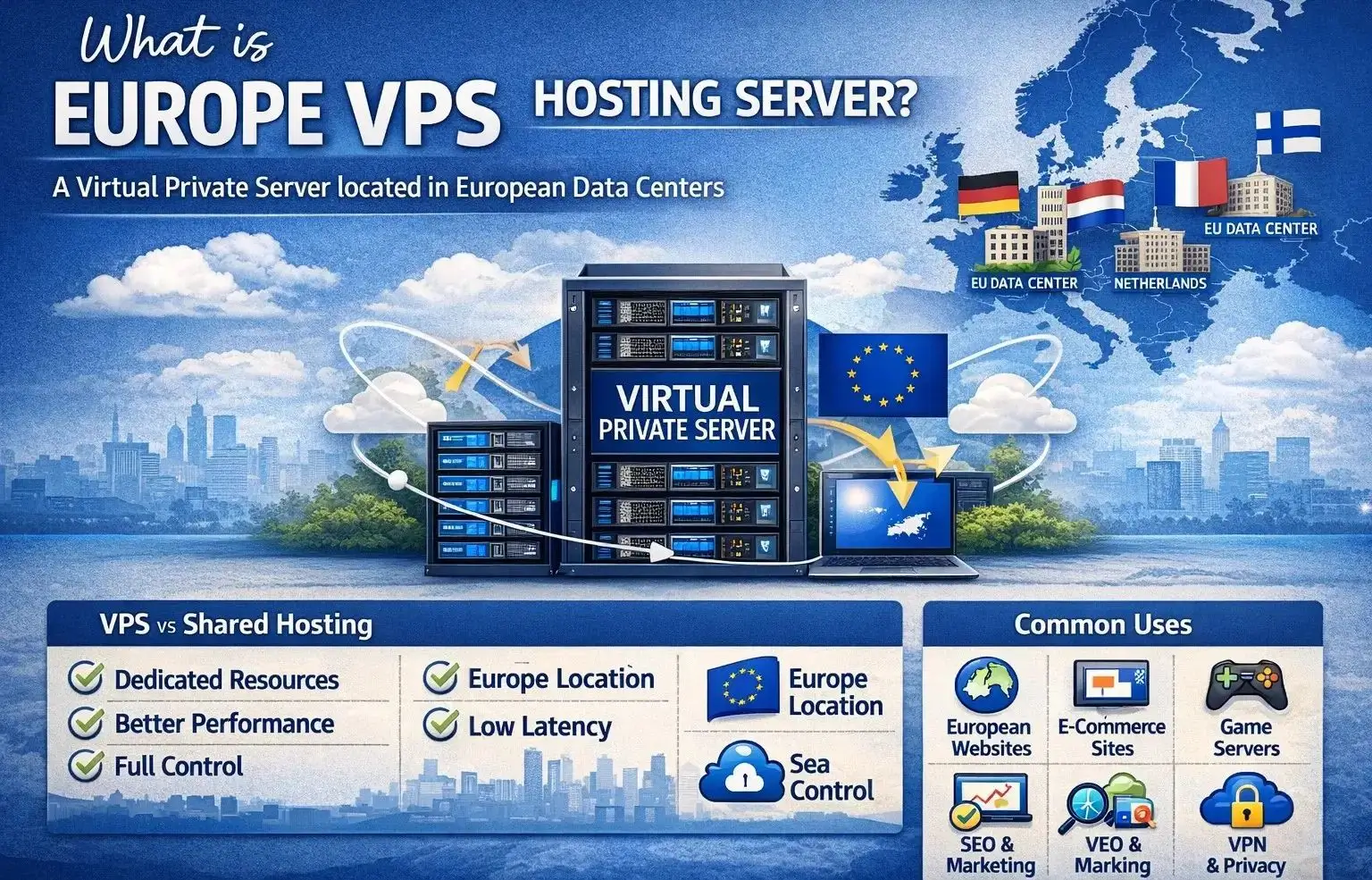
It uses virtualization technology to divide a powerful physical server into multiple isolated VPS instances, each with dedicated CPU, RAM, storage, and bandwidth.
You get full root access, better performance than shared hosting, and lower cost compared to a dedicated server while your data stays physically located in Europe.
How to Choose the Best Europe VPS hosting Server in 2026
Choosing the best Europe VPS hosting server in 2026 comes down to picking a setup that gives you fast speed, strong security, and smooth scalability for your audience. You want a VPS that not only performs well today but also handles future growth without issues.
- Pick the right EU location: Choose servers in Frankfurt, Amsterdam, or London so your users get faster loading and lower latency.
- Check NVMe + KVM technology: Make sure your VPS uses NVMe storage and KVM virtualization for better speed and stable performance.
- Focus on security features: Look for DDoS protection, firewall, malware scans, and regular backups to keep your website safe.
- Ensure easy scalability: Your provider should allow quick upgrades of CPU, RAM, and storage without downtime as traffic grows.
- Verify uptime and support: Choose a host offering 99.95%+ uptime with fast, helpful 24/7 support when issues appear.
- Confirm GDPR compliance: Make sure your data stays in Europe with clear privacy policies and proper legal compliance.
If you follow these points carefully, you’ll end up with a VPS that runs fast, stays secure, and scales easily, so your website performs smoothly without future headaches.
10 Best Europe VPS Hosting Servers in 2026, Oct
All picks below include EU data centers and modern stacks suited for high traffic sites. Each brand balances speed, security, scaling, and support differently.
1. YouStable – NVMe Powered EU Performance VPS
Best For: SMEs, agencies, and WooCommerce stores needing fast EU NVMe.
Price: Starts from $3.86-16.56/mo.

YouStable brings developer friendly EU VPS with fair pricing and clear, human support. It’s ideal when uptime, performance, and guidance matter equally.
YouStable stands out in Europe for balanced price to performance, developer centric features, and attentive support. With EU deployments across hubs like Amsterdam and Frankfurt through reputable partner facilities, YouStable delivers fast NVMe storage, KVM virtualization, and optional managed layers tuned for WordPress, WooCommerce, and custom stacks. I’ve seen consistent sub 50 ms latency to major EU eyeballs and reliable burst performance under load thanks to thoughtful CPU and RAM allocations.
Where YouStable excels is practical engineering: hardened templates, optimized NGINX/Apache configurations, and a sane backup policy that doesn’t surprise you at restore time. Their security stance, network level DDoS protection, kernel updates, and isolation, meets the needs of small SaaS teams and agencies hosting dozens of client sites. If you’re migrating from shared or an overprovisioned VPS, the onboarding team provides clean, downtime minimized moves and clear communication.
Key Feature of YouStable
What do these features mean for you? You get fast NVMe speed, strong security, and smooth scaling, so your EU websites stay stable, secure, and ready for growth.
- NVMe KVM VPS in EU hubs: You get fast NVMe storage with isolated resources, so your website stays smooth during traffic spikes.
- Managed security and hardening: You don’t worry about threats, as firewall rules, updates, and malware protection are handled automatically.
- Daily backups with snapshots: You always have restore points, helping you recover quickly if updates or errors break your site.
- WooCommerce optimized stack: Your store loads faster with tuned PHP and caching, improving conversions and user experience across EU traffic.
- Flexible scaling with IPv4/IPv6: You can upgrade resources easily while maintaining performance and avoiding future network limitations.
Plans & Pricing
Not sure which plan to choose? You can start small and upgrade anytime, with flexible pricing that fits your budget while still giving you strong performance and reliable EU VPS resources.
| Plan Name | CPU | RAM | Storage | Bandwidth | Monthly Price |
| vStart | 1 | 4GB | 50GB NVMe SSD | 4TB | $3.86 |
| vProfessional | 2 | 8GB | 100GB NVMe SSD | 8TB | $5.73 |
| vPopular | 4 | 16GB | 200GB NVMe SSD | 16TB | $8.28 |
| vStable | 8 | 32GB | 400GB NVMe SSD | 32TB | $16.56 |
Why Choose YouStable Europe VPS Hosting Server?
Looking for a VPS that actually delivers speed, stability, and support without confusion? YouStable gives you NVMe performance, EU data centers, and managed security so your website runs fast and stays protected.
You also get easy scaling, reliable backups, & helpful support, so you can focus on growing your project instead of handling server issues.
2. UltaHost – Affordable Managed EU VPS Hosting
Best for: SMBs and agencies seeking affordable, secure EU VPS with managed.
Price: Starts From $4.99/mo

UltaHost blends value and security for European workloads, with data centers close to major audiences and clear upgrade paths as you grow.
UltaHost offers competitive European VPS with a reputation for strong baseline security, generous bandwidth, and frequent promotions. With locations across Amsterdam, Frankfurt, and London, UltaHost’s KVM based NVMe plans give developers solid throughput and steady CPU access. Their one click panels (cPanel, DirectAdmin) and managed tiers make it easy for SMBs and agencies to move from shared to VPS without a steep learning curve.
From a reliability standpoint, UltaHost’s DDoS protection and automated backups are notable in this price bracket. It’s also a sensible pick for staging to production workflows and mid traffic ecommerce, where caching plus NVMe keeps tail latency under control. While power users may want deeper control over networking and BGP options, most businesses find the stack balanced and support responsive.
Key Feature of UltaHost
So what do you actually get here? A balance of performance, security, and easy management, making it simple for you to run and grow your website without stress.
- KVM virtualization with NVMe: You get stable performance and fast loading speeds, ideal for websites and applications across Europe.
- Free migration support: You can move your site easily without downtime, making switching from shared hosting simple.
- EU multiple server locations: You can choose closer regions, improving latency and overall user experience for your audience.
- DDoS protection included: Your website stays online during attacks, helping protect uptime and business reliability.
- Managed hosting options available: You don’t need technical skills, as experts handle updates, monitoring, and server security.
3. Hostinger – Budget Friendly EU VPS Solution
Best for: Budget conscious projects, blogs, and starter ecommerce targeting EU users.
Price: Starts from $4.99/mo

Hostinger’s EU VPS is a fast, affordable entry point for developers and creators who want control without complexity or steep costs.
Hostinger is known for aggressive pricing, modern NVMe infrastructure, and a lightweight control panel that’s friendly to beginners. In Europe, their data centers in Lithuania, the Netherlands, and the UK provide widespread coverage for consumer sites, blogs, and early stage ecommerce. Hostinger’s VPS portfolio focuses on simplicity: quick deployments, snapshots, and preconfigured Linux images that get you productive fast.
Performance is reliable for the price, and their tutorials and knowledge base are helpful for self service learners. While advanced sysadmins may outgrow some controls or need more granular networking, most small projects and freelancers find Hostinger’s VPS a smooth on ramp. Keep an eye on renewal pricing and consider managed add-ons if you prefer not to patch or tune services yourself.
Key Feature of Hostinger
If you want something simple and budget friendly, these features help you manage your VPS easily while still getting reliable speed and performance for daily use.
- Affordable VPS plans for beginners: You can start with low cost while still getting dedicated resources and stable performance.
- Easy control panel interface: You manage your server easily without needing advanced technical knowledge or command line expertise.
- EU data center availability: You can host closer to your audience, improving loading speed and SEO performance.
- Snapshots and backups included: You can test changes safely and restore your server quickly if something goes wrong.
- Helpful tutorials and guides: You can solve common issues yourself without waiting for support responses.
4. ScalaHosting – Managed VPS with SPanel Control
Best for: Agencies and resellers needing multi site control and cost efficient.
Price: Starts from $29.99/mo

ScalaHosting provides flexible EU deployments with SPanel’s cost savings and managed security, excellent for multi site portfolios.
ScalaHosting mixes its own stack (SPanel) with cloud partners (DigitalOcean/AWS) to offer flexible European footprints like Frankfurt, Amsterdam, and London. SPanel is lighter than cPanel, reducing overhead and licensing costs while keeping familiar workflows. For developers running multiple sites, Scala’s container like account isolation and automatic backups are appealing. Their managed tiers include security hardening and proactive monitoring that’s competitive at this price level.
In testing, I’ve seen Scala deliver stable performance under WordPress/WooCommerce and Laravel workloads, with quick support turnarounds. The blend of simplicity, choice of underlying cloud, and predictable pricing makes it a favorite for agencies and hosting resellers wanting control without the cPanel tax. If you need specialty networking scenarios, verify capabilities in advance.
Key Feature of ScalaHosting
Here, you get more control with less cost. These features help you manage multiple websites easily while keeping your server secure and stable.
- SPanel lightweight control panel: You save resources and cost while managing websites easily without paying expensive cPanel license fees.
- Multi cloud EU deployment: You can choose between different cloud providers, giving flexibility based on performance and budget needs.
- Automated daily backups: You keep your data safe with regular backups and quick restore options.
- Managed security system: You get firewalls, malware scans, and updates to keep your server protected.
- Staging tools for safe testing: You can test changes before going live, reducing risks and improving stability.
5. Hosting.com – Enterprise Grade EU VPS Infrastructure
Best for: Regulated industries and B2B SaaS needing EU data residency.
Price: Starts from $29/mo

Hosting.com emphasizes operational rigor and compliance in EU facilities, ideal when audits, SLAs, and stability outrank bargain pricing.
Hosting.com targets business customers needing stable EU VPS with straightforward management and compliance focus. Expect KVM virtualization, NVMe storage, and enterprise grade facilities in major European hubs like Amsterdam and Frankfurt. Their feature set leans toward reliability clear SLAs, ticket SLAs, and predictable usage billing over chasing the lowest sticker price, which suits finance, legal, and B2B SaaS with strict availability demands.
Support quality is a differentiator: staffed engineers, not just front line chat, and well documented processes for change control, maintenance windows, and incident response. If your team needs auditable workflows or has customer contracts tied to EU data residency, Hosting.com’s posture and documentation can simplify your compliance pack. Advanced autoscaling may require consulting; plan ahead for seasonal peaks.
Key Feature of Hosting.com
These features are built for reliability and compliance, so you can run serious projects with confidence, knowing your performance and security are well handled.
- Enterprise EU data centers: You get stable performance with infrastructure designed for compliance and business critical workloads.
- SLA backed uptime guarantee: You receive reliable service with clear uptime commitments and incident reporting.
- KVM with NVMe performance: Your applications run smoothly with consistent speed and minimal resource interference.
- Advanced security controls: You stay protected with firewalls, DDoS defense, and secure configurations.
- Professional support engineers: You get expert help for complex issues, reducing downtime and technical stress.
6. Cloudzy – Multi Location Low Latency EU VPS
Best for: Distributed workloads, traders, and devs needing many EU city choices.
Price: Starts from $7.48/mo

Cloudzy delivers location diversity, quick provisioning, and NVMe performance ideal for distributed EU experiments and automation tasks.
Cloudzy focuses on globally distributed VPS (including RDP) with strong European presence such as Amsterdam, Frankfurt, and London. They’re popular among traders, automation users, and developers who want low latency instances in many cities at competitive rates. Expect KVM virtualization, NVMe disks, and a mix of Windows and Linux images, making it flexible for cross platform teams and use cases like bots, scraping (within TOS), and lightweight microservices.
Cloudzy’s strengths are variety and reach. If you need to spread workloads across multiple EU countries for redundancy or A/B testing, they provide a broad map without multi cloud complexity. Security is decent for the segment; however, enterprise buyers should validate DDoS tiers and incident procedures. For fast provisioning and city level choice, Cloudzy offers good value.
Key Feature of Cloudzy
What does this mean for you? You get flexibility and location choice, so your apps run faster across Europe without worrying about latency issues.
- Wide EU city coverage: You can deploy servers in multiple locations, improving performance for region specific users.
- NVMe storage with KVM: Your apps run fast and stable even during high I/O workloads.
- Quick server deployment: You can launch VPS instantly, saving time for testing and development tasks.
- Flexible API and scaling: You can adjust resources anytime based on traffic or workload changes.
- IPv4 and IPv6 support: You ensure future ready networking and better connectivity across regions.
7. RoseHosting – Fully Managed Linux VPS Experts
Best for: Prioritizing top tier managed help over strict EU data residency.
Price: Starts from $43.99/mo

RoseHosting’s value is expert management that feels like an extension of your team, ideal when operations time is your scarcest resource.
RoseHosting is renowned for deeply managed VPS and knowledgeable Linux support. While their primary data center footprint is US centric, they remain a credible choice for European customers who value hands-on management, security hardening, and application level assistance. For EU focused sites where a US location is acceptable (or where CDNs and caching mitigate latency), RoseHosting’s fully managed stack is a standout.
Their engineers handle server setup, stack tuning, and ongoing maintenance, which is rare at mid market price points. If your team prefers to focus wholly on app features or content rather than Linux administration, RoseHosting is worth consideration. For strict EU data residency, however, pick an EU native location from other providers in this list.
Key Feature of RoseHosting
If you prefer hands off management, these features give you expert support and stability, so you can focus on your work instead of server tasks.
- Fully managed Linux support: You don’t need technical expertise, as experts handle server setup, updates, and optimization.
- Optimized server configurations: Your applications run efficiently with tuned environments for PHP, databases, and web servers.
- Proactive monitoring system: You avoid downtime as issues are detected and fixed before affecting performance.
- Migration assistance included: You can move your website safely with minimal downtime and proper guidance.
- Reliable backup solutions: You always have recovery options, ensuring your data stays safe.
8. Kamatera – Flexible Cloud VPS with Scaling
Best for: DevOps teams needing configurable EU cloud VPS with rapid scaling.
Price: Typical EU starting range in 2026: €10–€20/month; pay per use can vary.

Kamatera delivers cloud flexibility and EU choice without hyperscaler sprawl, excellent for dynamic, multi instance architectures.
Kamatera operates as a true cloud platform with granular sizing, per minute billing, and EU regions such as London, Amsterdam, and Frankfurt. It’s ideal for teams needing fine control over vCPU/RAM combinations, private networking, and multi VPS topologies. Think of Kamatera as a flexible alternative to hyperscalers for those who want predictable performance and hands on support without hyperscaler complexity or costs.
For bursty workloads and test environments, Kamatera shines: you can scale resources up or down quickly and script deployments. Expect NVMe storage, advanced networking options, and both Windows and Linux images. Managed services are available if you want the convenience of patching and monitoring handled for you, making Kamatera appropriate for both DevOps teams and growing SMEs.
Key Feature of Kamatera
You get full control and flexibility here, allowing you to scale resources anytime and build your server exactly the way your project needs.
- Custom server configuration: You get full control to choose exact CPU, RAM, and storage, so your server fits your workload perfectly.
- Instant resource scaling: Traffic suddenly increases ho jaye? You can scale resources anytime without downtime or service interruption.
- Multiple EU data centers: You can place your server closer to your users, which helps reduce latency and improve loading speed.
- Advanced networking features: You can create secure setups using private networks, firewalls, and custom configurations for better control and safety.
- Pay as you use billing: You only pay for what you actually use, so you can manage costs smartly without wasting budget.
9. Verpex – Agency Friendly Managed VPS Hosting
Best for: Agencies and resellers scaling client sites on EU VPS with support.
Price: Starts from $9.99/mo

Verpex streamlines EU VPS for agencies, easy management, helpful support, and fair pricing without enterprise complexity.
Verpex is popular with agencies and resellers due to friendly pricing, helpful support, and EU locations such as London and Amsterdam. Their managed VPS options simplify maintenance, while white label possibilities make it attractive for service providers building branded hosting offerings. Expect KVM virtualization, NVMe storage, and predictable performance for multi site WordPress portfolios and client workloads.
Verpex emphasizes customer care and easy scaling. For teams moving from reseller hosting to VPS, it’s a logical next step that doesn’t overwhelm you with complexity. The platform’s balance of features and cost makes it a strong middle ground option between barebones VPS and premium enterprise stacks.
Key Feature of Verpex
These features are helpful if you manage multiple sites, giving you easy tools, stable performance, and support that keeps everything running smoothly.
- Agency friendly hosting environment: If you manage client websites, you get simple tools that make handling multiple projects much easier.
- NVMe storage with KVM isolation: Your websites stay fast and stable because resources are dedicated and not affected by other users.
- Free migration services: Switching from another host becomes easy, as your site is moved without downtime or technical hassle.
- Automated backups included: You always have backup copies ready, so you can restore your site quickly if something goes wrong.
- Responsive support team: Whenever you get stuck, you receive quick and helpful support, keeping your websites running smoothly.
10. AccuWebHosting – Flexible VPS with Global Support
Best for: Teams needing configurable EU VPS for both Windows and Linux.
Price: Starts from $4.99/mo.

AccuWebHosting offers a wide selection of VPS configurations with EU locations such as Frankfurt, London, and Amsterdam. It’s a versatile choice for both Windows and Linux workloads, including RDP users, developers, and SMBs. The plans feature KVM virtualization, NVMe storage on newer tiers, and generous bandwidth, all backed by helpful documentation and responsive ticket support.
AccuWebHosting’s appeal is configurability: pick OS, control panel, and resource mix tailored to your apps. They provide free migrations on many plans and good backup options. While UI polish isn’t the marquee feature, the practical capabilities and honest pricing make it a smart option for teams that know what they need and value reliability over flair.
Key Feature of AccuWebHosting
With these features, you get flexibility and control, so you can run different types of projects while keeping performance and stability in check.
- Flexible VPS configurations: You can build your server exactly how you need it, without paying for resources you don’t use.
- Windows and Linux support: Whether you prefer Linux or Windows, you can run your projects easily based on your requirements.
- NVMe storage performance: Your applications load faster with high speed storage, improving overall website performance and user experience.
- EU data center locations: Hosting closer to your audience helps your website load faster and improves SEO performance.
- Reliable support system: You get consistent help for setup, migration, and issues, making server management easier even for beginners
Selection Criteria, Benchmarks, and EU Performance Tactics
We prioritized NVMe, KVM, modern CPUs, and peering at DE-CIX, AMS-IX, and LINX. We valued GDPR readiness, snapshot backups, and true 24/7 support quality.
Tests favored low p95 and p99 response times, not just peak speed. Consistent performance under load, clean migrations, and reliable restores mattered most.
To rank providers, I weighed real world web stack needs, WordPress/WooCommerce, Laravel/Node APIs, and SaaS dashboards under European traffic patterns. I looked for providers with sub 50 ms latency to major EU metros, dependable 99.95–99.99% uptime, automated backups, and workable DDoS layers. I also favored vendors with IPv6 ready networks, transparent status pages, and straightforward billing that won’t surprise you at renewal.
For best results, place your VPS closest to the heaviest audience cohort. Use a CDN with EU PoPs (and origin shield) for static assets. Enable HTTP/2 or HTTP/3, tune PHP-FPM workers to memory, and deploy object caching (Redis or Memcached) for dynamic sites. Finally, test during your true peak hours; synthetic off peak tests often miss the real bottlenecks.
Use Cases and Which Europe VPS Host Fits Them Best
Ecommerce needs cache friendly NVMe, DDoS, and strong backups. Agencies need multi site management, migrations, and predictable support response.
DevOps teams prefer granular scaling, staging, and private networking. Regulated firms value SLAs, audit trails, and clear EU data residency terms.
- WooCommerce stores: YouStable, ScalaHosting, UltaHost for optimized PHP-FPM, Redis, and practical managed help.
- Agencies with client portfolios: Verpex or ScalaHosting (SPanel), with YouStable for hands on migrations and security ops.
- DevOps and multi instance apps: Kamatera for granular sizing and private networking; Cloudzy for distributed regional testing.
- Regulated B2B/enterprise: Hosting.com for auditable processes and SLA-first operations.
- Windows/RDP needs in EU: AccuWebHosting, Cloudzy, or Kamatera depending on control and cost goals.
GDPR, Data Residency, and Security in EU VPS Hosting
Confirm where your data lives and which sub processors are used. Ask for DPA, SCCs, and incident processes. Ensure encryption in transit and at rest.
Assess DDoS tiers and WAF policies; review backup retention and test restores. Map access controls, MFA, and logging to your compliance framework.
In 2026, GDPR compliance remains foundational. Choose providers that offer EU only data residency or clear data flows for third country transfers. Use full disk encryption options when available and secure secret stores for credentials.
Require MFA for panel and SSH keys for server logins. Finally, rehearse incident response by performing a real restore and measuring RPO/RTO, paper compliance is not enough for production workloads.
FAQs
Which Europe VPS Location is Fastest for Most Users?
Frankfurt and Amsterdam are typically fastest due to dense peering (DE-CIX, AMS-IX) and central geography. London and Paris are close seconds. Pick the city nearest your largest audience for best results.
Is NVMe Really Worth it Over SATA SSD for VPS?
Yes. NVMe delivers significantly higher IOPS and lower latency, which improves database queries, cache hits, and p95/p99 response times, especially noticeable on busy WordPress and ecommerce sites.
Do I Need a Managed VPS or is Unmanaged Fine?
If you lack in house Linux expertise or run revenue critical sites, choose managed for patching, monitoring, backups, and security. Unmanaged is cheaper but shifts responsibility to your team.
How Much RAM and CPU Does a Typical EU ecommerce Site Need?
Start with 2–4 vCPU and 4–8 GB RAM for WooCommerce/Magento, plus Redis and NVMe. Monitor real usage, then scale to 6–8 vCPU and 12–16 GB RAM during peak seasons.
What Uptime SLA Should I Expect From a Top EU VPS Host?
Look for 99.95%–99.99% with documented credits, status pages, and incident reports. The SLA should cover maintenance windows and network as well as hardware failures.
Is IPv6 Support Necessary in 2026?
Yes. With IPv4 scarcity, IPv6 readiness ensures reachability and future proofs your stack. Your provider should support dual stack and clean IPv6 routing across EU backbones.
Can I Migrate From Shared Hosting to an EU VPS Without Downtime?
Yes. Use provider assisted migration, test on a staging domain, then switch DNS with a low TTL. Schedule during off peak hours and validate cache/SSL before the final cutover.
Conclusion
Start with server location to ensure low latency for European users, then focus on performance essentials, NVMe storage, KVM virtualization, and modern CPUs. Balance managed support against your team’s time and technical skills before deciding.
For a clear, reliable choice, YouStable, QloudHost and UltaHost stand out. Both deliver strong EU VPS performance, transparent pricing, responsive support, and scalable plans that work well for growing websites, SaaS projects, and businesses targeting Europe.
Before committing, always verify SLAs, backup policies, and DDoS protection, and test restore options. Choosing the right Europe VPS today helps you avoid performance bottlenecks and costly migrations as you scale tomorrow.