To monitor and secure a Linux VPS, apply updates, harden SSH, enforce a firewall, enable brute-force protection, turn on automatic security patches, monitor logs and metrics, add file integrity and audit trails, back up regularly, and set actionable alerts. Start with least privilege, document your baseline, and review security weekly.
Securing and monitoring a VPS hosting environment on a Linux server isn’t a one-time task—it’s an ongoing practice. In this guide, I’ll show you how to secure a Linux VPS and build reliable VPS monitoring using proven tools and workflows I’ve implemented for clients over the last decade. We’ll keep it beginner-friendly, practical, and production-ready.
What You’re Protecting and Why Monitoring Matters
Attackers target exposed services (SSH, web, databases), weak credentials, unpatched software, and misconfigurations. Security reduces your attack surface; monitoring detects issues early. You need both.
Key signals to watch
- Auth and SSH: failed logins, root attempts, new SSH keys.
- Network: unusual ports, spikes, outbound traffic anomalies.
- CPU, RAM, disk: sustained spikes, I/O wait, running out of inode/space.
- Processes and services: new daemons, unexpected listeners, crashed services.
- File integrity: changes to /etc, web roots, crontabs, binaries.
- Web and DB: 4xx/5xx bursts, slow queries, unexpected schema changes.
Build a Strong Security Baseline First
1) Patch management and automatic security updates
Keep the kernel and packages current. Enable unattended security updates to minimize exposure windows. Schedule a monthly maintenance window for reboots and major upgrades.
# Debian/Ubuntu
sudo apt update && sudo apt -y upgrade
sudo apt install -y unattended-upgrades apt-listchanges
sudo dpkg-reconfigure -plow unattended-upgrades

# RHEL/CentOS/Alma/Rocky
sudo dnf check-update
sudo dnf -y update
sudo dnf install -y dnf-automatic
sudo systemctl enable --now dnf-automatic.timer
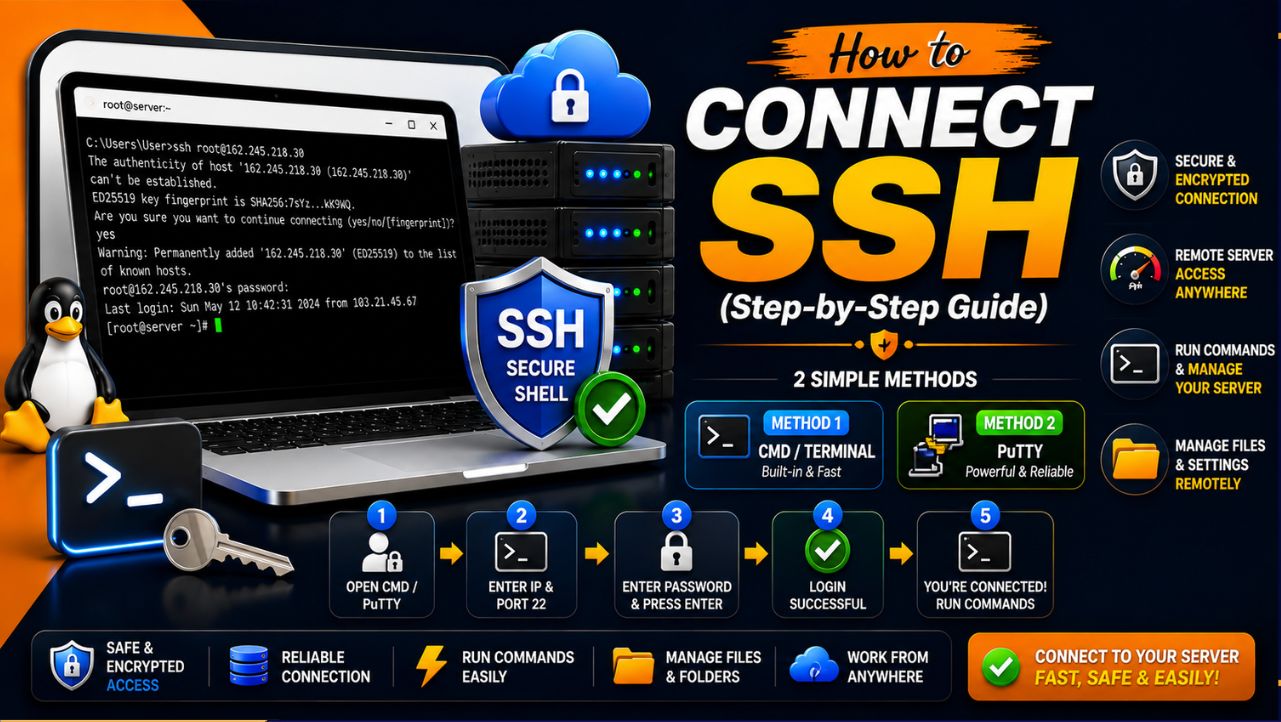
2) Harden SSH (the front door)
- Use SSH keys, not passwords.
- Disable root SSH login; use a sudo user.
- Limit to Protocol 2 and a short list of ciphers/MACs.
- Optional: move SSH to a high port to reduce noise (not a true control, but lowers brute-force noise).
# Create a sudo user
sudo adduser devops
sudo usermod -aG sudo devops
sudo mkdir -p /home/devops/.ssh && sudo chmod 700 /home/devops/.ssh
sudo sh -c 'cat >> /home/devops/.ssh/authorized_keys' <<EOF
ssh-ed25519 AAAA... your_public_key
EOF
sudo chmod 600 /home/devops/.ssh/authorized_keys
sudo chown -R devops:devops /home/devops/.ssh

# Harden SSHD
sudo cp /etc/ssh/sshd_config /etc/ssh/sshd_config.bak
sudo nano /etc/ssh/sshd_config
# Add or adjust:
Port 2222
PermitRootLogin no
PasswordAuthentication no
PubkeyAuthentication yes
Protocol 2
ClientAliveInterval 300
ClientAliveCountMax 2
AllowUsers devops
# Restart
sudo systemctl restart sshd
3) Firewall: UFW, nftables, or iptables
Allow only required ports (SSH, HTTP/HTTPS, and any app ports). Default-deny everything else. UFW is simplest on Ubuntu; nftables is the modern backend on many distros.
# UFW example
sudo apt install -y ufw
sudo ufw default deny incoming
sudo ufw default allow outgoing
sudo ufw allow 2222/tcp    # SSH port from above
sudo ufw allow 80,443/tcp  # Web
sudo ufw enable
sudo ufw status verbose
4) Brute-force protection with Fail2ban or CrowdSec
Fail2ban bans IPs that trip log-based rules. CrowdSec adds community-powered reputation. Start with SSH jails, then add Nginx/Apache and Postfix if applicable.
# Fail2ban (Ubuntu)
sudo apt install -y fail2ban
sudo cp /etc/fail2ban/jail.conf /etc/fail2ban/jail.local
sudo nano /etc/fail2ban/jail.local
# Example overrides:
[DEFAULT]
bantime = 1h
findtime = 10m
maxretry = 5

[sshd]
enabled = true
port = 2222
logpath = %(sshd_log)s
backend = systemd

sudo systemctl enable --now fail2ban
sudo fail2ban-client status
sudo fail2ban-client status sshd
5) Least privilege, users, and files
- Grant sudo only to those who need it and require MFA on your control panel or jump host.
- Use restrictive file permissions for app configs, keys, and database credentials.
- Limit cron jobs and review them monthly.
6) Mandatory access control: SELinux or AppArmor
Enforce kernel-level policy to confine processes. AppArmor (Ubuntu) and SELinux (RHEL family) can contain damage if a service is compromised. Start in enforcing mode and tailor profiles gradually.
Set Up VPS Monitoring That Catches Problems Early
System metrics and service health
- Metrics: CPU, load, RAM, swap, disk usage, I/O wait, network throughput.
- Service uptime: web, DB, cache, queue runners.
- Tools: Netdata (easy), Prometheus + Node Exporter + Grafana (scalable), Monit/systemd for restarts.
# Quick views
top     # or htop
vmstat 1
iostat -xz 1
ss -tulpn   # listening sockets
systemctl --failed
Centralize and search logs
Aggregate logs for SSH, web, app, and database. Start with rsyslog and logrotate; graduate to ELK/OpenSearch or Loki if you outgrow grep and journalctl.
# View recent auth attempts
sudo journalctl -u ssh -S -24h

# Log rotation sanity check
cat /etc/logrotate.d/* | wc -l
Audit trails and file integrity
- auditd: records security-relevant events (file access, exec calls, privilege use).
- AIDE: detects unexpected file changes in critical paths.
# auditd
sudo apt install -y auditd audispd-plugins
sudo systemctl enable --now auditd
sudo augenrules --load
# Example rule: watch passwd/shadow
echo "-w /etc/shadow -p wa -k shadow" | sudo tee /etc/audit/rules.d/shadow.rules
sudo augenrules --load
sudo ausearch -k shadow | aureport -f

# AIDE
sudo apt install -y aide
sudo aideinit
sudo mv /var/lib/aide/aide.db.new /var/lib/aide/aide.db
sudo aide --check
Network visibility and anomaly detection
- Use ss or netstat to review listeners; vnStat or nload to spot spikes.
- Consider Wazuh/OSSEC for host intrusion detection if you need correlation and alerts.
- Enable DDoS protection at the edge (e.g., provider or CDN) and rate-limit at Nginx.
# Quick network checks
ss -s
ss -tulpn | grep LISTEN
sudo apt install -y nload && sudo nload
Practical Hardening and Monitoring Snippets
Lynis baseline audit
Lynis provides a fast security audit and clear recommendations based on common Linux server hardening practices.
sudo apt install -y lynis
sudo lynis audit system | tee ~/lynis-report.txt
Sysctl network hardening
Apply safe network sysctl settings to reduce spoofing and scanning risk. Adjust if your server routes or needs special networking.
sudo tee /etc/sysctl.d/99-hardening.conf >/dev/null <<EOF
net.ipv4.icmp_echo_ignore_broadcasts = 1
net.ipv4.conf.all.rp_filter = 1
net.ipv4.tcp_syncookies = 1
net.ipv4.conf.all.accept_source_route = 0
net.ipv4.conf.default.accept_redirects = 0
net.ipv4.conf.all.accept_redirects = 0
net.ipv6.conf.all.accept_redirects = 0
kernel.kptr_restrict = 2
kernel.dmesg_restrict = 1
EOF
sudo sysctl --system
Nginx rate limiting (simple DDoS/abuse control)
# /etc/nginx/conf.d/ratelimit.conf
limit_req_zone $binary_remote_addr zone=req_per_ip:10m rate=5r/s;

# In your server block
location / {
  limit_req zone=req_per_ip burst=10 nodelay;
  try_files $uri $uri/ /index.php?$args;
}
Cron a daily AIDE check and update
(crontab -l 2>/dev/null; echo "15 2 * * * /usr/bin/aide --check | /usr/bin/logger -t AIDE") | crontab -Backups, Recovery, and Incident Response
3-2-1 backups and tested restores
- Keep 3 copies, on 2 different media, 1 offsite.
- Automate daily database and weekly full backups; encrypt at rest.
- Test a restore monthly; a backup you can’t restore is no backup.
When you suspect compromise
- Isolate: snapshot, detach from network or restrict to a forensics VLAN.
- Collect: copy logs, memory if possible, and running process lists.
- Eradicate: rebuild from clean images; rotate credentials and keys.
- Recover: restore data, patch, and conduct a post-incident review.
Ongoing Maintenance Checklist
- Daily: review alerts (auth, disk, service health), check backups.
- Weekly: apply patches, inspect new users/keys, review Fail2ban bans.
- Monthly: run Lynis, test restores, rotate secrets, prune services and ports.
- Quarterly: update OS release if applicable, refresh incident runbooks, verify monitoring coverage.
Managed vs. Self-Managed: Which Fits You?
If your team can’t dedicate time to continuous Linux VPS security and monitoring, consider a managed VPS. At YouStable, our managed plans include hardened images, 24/7 monitoring, proactive patching, and DDoS protection—freeing you to focus on your app while we watch the layers beneath. For hands-on teams, our self-managed VPS includes the raw power and root access you need with optional security add-ons.
Common Mistakes to Avoid
- Relying on passwords for SSH or leaving root login enabled.
- Open ports “just in case” instead of least privilege.
- Skipping automatic security updates due to fear of breakage; use maintenance windows instead.
- No alerting—collecting metrics without notifications.
- Unverified backups—never tested restores.
- Assuming a CDN or WAF alone secures the origin server.
Step-by-Step Quickstart (Copy/Paste)
# 1) Update and enable auto security updates
sudo apt update && sudo apt -y upgrade
sudo apt install -y unattended-upgrades fail2ban ufw lynis aide auditd

# 2) Create sudo user, install SSH key, disable root login
sudo adduser devops && sudo usermod -aG sudo devops
# Add your SSH key to /home/devops/.ssh/authorized_keys
sudo sed -i 's/^#?PermitRootLogin.*/PermitRootLogin no/' /etc/ssh/sshd_config
sudo sed -i 's/^#?PasswordAuthentication.*/PasswordAuthentication no/' /etc/ssh/sshd_config
echo "Port 2222" | sudo tee -a /etc/ssh/sshd_config
sudo systemctl restart sshd

# 3) Firewall
sudo ufw default deny incoming
sudo ufw default allow outgoing
sudo ufw allow 2222/tcp
sudo ufw allow 80,443/tcp
sudo ufw enable

# 4) Fail2ban
sudo systemctl enable --now fail2ban

# 5) Baseline audits and integrity
sudo lynis audit system
sudo aideinit && sudo mv /var/lib/aide/aide.db.new /var/lib/aide/aide.db

# 6) Enable auditd rules
sudo systemctl enable --now auditd

# 7) Monitoring essentials
sudo apt install -y htop nload
htop
nload
FAQs: How to Monitor & Secure VPS Hosting on Linux
What is the best way to secure a Linux VPS for beginners?
Start with updates, SSH key authentication, disabling root login, enabling a firewall, and setting up Fail2ban. Add automatic security updates, regular backups, and a simple monitoring stack like Netdata. These steps deliver the biggest gains with minimal complexity.
How do I monitor a VPS in real time without complex setups?
Install Netdata for a one-command dashboard, or use htop, nload, and journalctl for quick terminal checks. Add external uptime monitoring (e.g., a SaaS ping/HTTP checker) for off-server visibility and alerting.
Is changing the SSH port necessary for security?
It’s optional. Changing the port reduces noise from automated scans but isn’t a true control. The real protections are SSH keys, no root login, and a firewall. Use a nonstandard port if it simplifies your log review.
Do I need SELinux or AppArmor on a VPS?
Yes, if possible. Mandatory access control confines services and limits blast radius. It requires some learning, but even default policies meaningfully improve Linux server hardening for web and database workloads.
How often should I run security audits on my VPS?
Run Lynis monthly, review logs weekly, and patch weekly. After major app or system changes, repeat an audit. Test a full restore every month so you can confidently recover from incidents or operator errors.
By following this playbook, you’ll secure a Linux VPS with a strong baseline and implement VPS monitoring that actually alerts you before issues escalate. If you want a head start, YouStable’s managed VPS hardens and monitors from day one—so you can ship features, not patch windows.