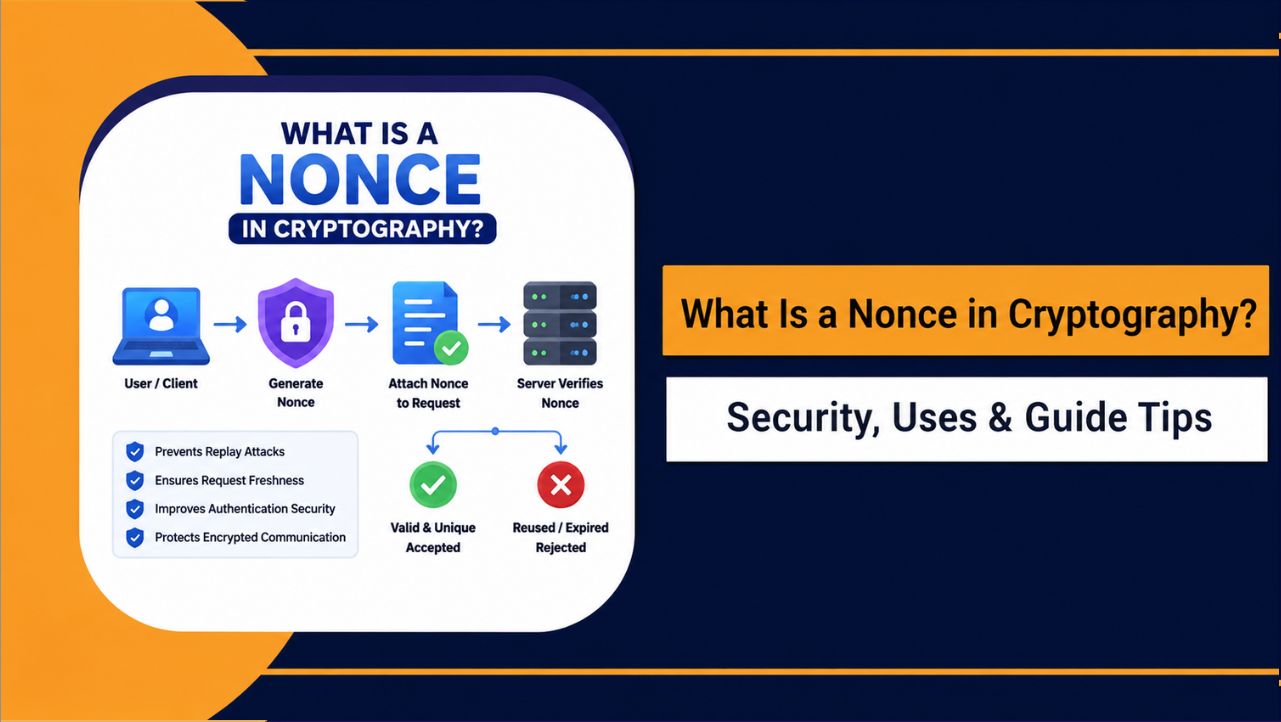
A nonce in cryptography is a unique one time value used during encryption and authentication to prevent replay attacks, duplicate requests, and unauthorized reuse of secure communication.
Modern cybersecurity systems do much more than simply protect data with passwords and encryption keys. Every secure login, API request, online payment, and encrypted session must verify that the communication is fresh, valid, and not secretly reused by attackers. This is exactly why nonces are now considered one of the most important building blocks behind secure digital communication and modern cryptographic protection.
Today, nonces are widely used in TLS encryption, authentication systems, secure APIs, WordPress security, and even Bitcoin mining systems. You will understand how nonces work, why nonce reuse is dangerous, where they are used in real world security systems, and which best practices help maintain stronger encryption, authentication security, and trusted communication online.
What Is a Nonce in Cryptography?
A nonce in cryptography is a unique value used only once during encryption, authentication, or secure communication processes. Its main purpose is to prevent replay attacks, duplicate requests, and unauthorized reuse of valid data.
Modern encryption systems like AES-GCM and ChaCha20-Poly1305 use nonces to maintain data freshness, integrity, and secure cryptographic communication across modern digital systems.
Why Nonces Matter in Modern Security?
Modern cybersecurity systems face threats like replay attacks, duplicate requests, session hijacking, and manipulated communication. Nonces help reduce these risks by ensuring every request or encrypted operation remains unique, fresh, and valid. This improves authentication security and helps maintain trusted communication across modern digital systems.
Main Security Benefits of Nonces
- Prevent replay attacks: Stops attackers from reusing valid requests
- Protect encrypted communication: Keeps encryption operations secure
- Improve authentication security: Helps verify genuine user sessions
- Ensure request freshness: Confirms requests are new and valid
- Prevent duplicate requests: Reduces repeated transaction risks
| Security Benefit | Why It Matters |
| Replay Attack Protection | Stops attackers from reusing valid requests |
| Encryption Freshness | Keeps encrypted operations unique |
| Authentication Security | Helps verify valid sessions |
| API Request Validation | Prevents duplicate transactions |
| Secure Communication | Improves data integrity and trust |
Because of these benefits, nonces are widely used in modern encryption systems, authentication protocols, APIs, blockchain networks, and secure communication technologies.
How a Nonce Works in Cryptography?
A nonce works by generating a unique value for every encryption, authentication, or secure communication request. This value is attached to the operation before processing begins. When the request reaches the receiving system, the nonce is verified to confirm it has not already been used or duplicated.
If the nonce is valid and unique, the request is accepted successfully. If the same nonce appears again, the system rejects the request automatically to prevent replay attacks or unauthorized reuse of valid communication. This process helps maintain freshness, integrity, and trust in modern cryptographic systems.
Basic Nonce Verification Process
| Step | What Happens |
| Nonce Generation | System creates a unique nonce value |
| Request Attachment | Nonce is added to encrypted data or request |
| Verification Process | Receiver checks nonce validity and uniqueness |
| Duplicate Protection | Reused or expired nonces are rejected |
Because of this validation process, nonces are widely used to improve encryption security, authentication protection, and trusted communication across modern digital systems.
4 Types of Nonces Used in Cryptography
Different cryptographic systems use different types of nonces depending on how encryption, authentication, and secure communication are managed securely.
1. Random Nonces
Random nonces are generated using cryptographically secure random generators to improve encryption security and reduce replay attack or prediction risks.
| Feature | Details |
| Generation Method | Created using secure random generators |
| Main Advantage | Difficult for attackers to predict |
| Common Usage | Encryption and authentication systems |
2. Sequential Nonces
Sequential nonces use incrementing values for every new request, helping systems maintain uniqueness during communication and transaction processing securely.
- Uses counter based nonce generation
- Helps prevent duplicate nonce reuse
- Commonly used in APIs and payment systems
3. Deterministic Nonces
Deterministic nonces are generated using predefined algorithms and are mainly used in specialized cryptographic systems requiring controlled nonce generation.
| Feature | Details |
| Generation Method | Uses predefined calculations |
| Main Benefit | Maintains controlled nonce generation |
| Common Usage | Digital signatures and specialized cryptography |
4. Time Based Nonces
Time based nonces use timestamps during generation to verify request freshness and improve temporary validation in secure communication systems.
- Uses timestamps for freshness validation
- Helps verify recent requests
- Usually combined with random values for better security
Where Nonces Are Used in Cryptography?
Nonces are widely used in modern cryptography, authentication systems, APIs, blockchain networks, and secure communication protocols. Their main purpose is to maintain freshness, prevent replay attacks, and ensure every request or encryption operation remains unique and secure.
1. Nonces in Encryption
Encryption systems use nonces to ensure encrypted operations remain unique and protected against replay or duplication related attacks.
| Common Usage | Why It Matters |
| AES-GCM | Maintains secure authenticated encryption |
| ChaCha20-Poly1305 | Protects encrypted communication securely |
| Stream Ciphers | Prevents repeated encryption patterns |
2. Nonces in Authentication Systems
Authentication systems use nonces to verify login requests, sessions, and multi-factor authentication processes securely.
- Helps validate user sessions
- Prevents reused login requests
- Improves authentication security
3. Nonces in TLS and HTTPS
Protocols like TLS and HTTPS use nonces to maintain secure encrypted communication between servers and users.
| Security Purpose | Why It Matters |
| Session Protection | Keeps communication secure |
| Replay Prevention | Blocks reused packets |
| Encryption Freshness | Maintains secure connections |
4. Nonces in APIs
Modern APIs use nonces to validate requests and prevent duplicate transactions or manipulated communication attempts.
- Protects payment transactions
- Prevents duplicate API requests
- Improves request verification security
5. Nonces in Blockchain
Blockchain systems use nonces during mining and Proof of Work processes to generate valid hashes securely.
| Blockchain Usage | Purpose |
| Bitcoin Mining | Generates valid block hashes |
| Proof of Work | Maintains blockchain validation |
| Hash Calculations | Supports secure mining operations |
6. Nonces in WordPress Security
WordPress uses nonces mainly for CSRF protection and secure action verification.
- Protects form submissions
- Prevents unauthorized actions
- Improves request validation security
How Nonces Prevent Replay Attacks?
Nonces help prevent replay attacks by ensuring every request, transaction, or encrypted operation contains a unique value. If an attacker captures a valid request and tries to resend it later, the system detects the reused nonce and rejects the request automatically.
What Is a Replay Attack?
A replay attack happens when attackers intercept valid communication and resend it to perform unauthorized actions without changing the original data.
| Replay Attack Risk | Why It Is Dangerous |
| Duplicate Transactions | Can trigger repeated payments or requests |
| Session Hijacking | Allows attackers to reuse valid sessions |
| Unauthorized Access | May bypass normal authentication checks |
How Nonces Stop Replay Attacks
Nonce validation helps systems verify that every request is fresh, unique, and not reused from previous communication attempts.
- Every request receives a unique nonce
- Reused nonces are rejected automatically
- Expired requests become invalid
- Session freshness remains protected
Because of this process, nonces are widely used in APIs, authentication systems, encryption protocols, and secure communication technologies to reduce replay attack risks.
Nonce vs Salt vs IV
Nonce, salt, and IV are commonly used security terms in cryptography, but each serves a different purpose. Understanding these differences is important because using the wrong cryptographic component incorrectly can weaken encryption, authentication, or password security.
| Feature | Nonce | Salt | IV |
| Main Purpose | Maintains freshness and uniqueness | Protects password hashes | Initializes encryption process |
| Reuse Allowed | No | Sometimes | Depends on encryption mode |
| Usually Secret | No | No | Sometimes |
| Common Usage | Authentication, APIs, encryption | Password hashing | Block cipher operations |
| Primary Security Goal | Prevent replay attacks | Prevent hash matching attacks | Improve encryption randomness |
- Nonce: A nonce is mainly used to ensure every cryptographic request or encryption operation remains unique and fresh during secure communication.
- Salt: A salt is added to passwords before hashing to prevent attackers from using precomputed hash tables like rainbow tables.
- IV (Initialization Vector): An IV is used during encryption to ensure identical plaintext does not generate identical ciphertext repeatedly.
Recommended Nonce Lengths
Nonce length is important because very small nonces can increase collision risks, while properly sized nonces help maintain secure and reliable cryptographic communication. Different encryption systems and authentication protocols use different recommended nonce sizes depending on their security requirements.
| Use Case | Recommended Length | Why It Matters |
| AES-GCM | 96 bits | Helps maintain secure authenticated encryption |
| ChaCha20-Poly1305 | 96 bits | Improves encryption freshness and uniqueness |
| APIs and Tokens | 128 bits | Reduces duplicate request risks |
| Authentication Systems | 128 bits or higher | Improves session and login security |
| Blockchain Systems | Depends on protocol | Varies based on mining and validation requirements |
Using recommended nonce lengths helps reduce prediction risks, replay attacks, and accidental nonce reuse in modern cryptographic systems.
How to Generate Secure Nonces (Easy Guide)
Generating secure nonces correctly is important because weak or repeated nonces can create serious encryption and authentication vulnerabilities. Modern cryptographic systems use carefully generated nonces to maintain freshness, uniqueness, and secure communication during every operation.
Step 1 – Use a Cryptographically Secure Random Generator
Always generate nonces using cryptographically secure random number generators (CSPRNGs) instead of normal random functions. Secure generators create highly unpredictable values that are much harder for attackers to guess, manipulate, or reuse during encryption and authentication processes.
Modern encryption systems commonly rely on secure Linux server environments for safe cryptographic operations and stronger randomness generation. Many developers prefer secure Linux VPS hosting because it supports trusted security tools like OpenSSL, HTTPS, TLS, and /dev/urandom for protected communication and advanced encryption security.
Examples of Secure Generators
- /dev/urandom on Linux
- CryptGenRandom on Windows
- SecureRandom in Java
- openssl rand in OpenSSL
Step 2 – Generate a Unique Nonce for Every Operation
Every encryption request, session, API call, or authentication process should receive a completely new nonce value. Reusing the same nonce under the same encryption key can weaken cryptographic security significantly.
Important Rule
- Never reuse nonces with the same encryption key
Step 3 – Use Recommended Nonce Lengths
Nonce length should match the security requirements of the cryptographic system being used. Small nonces increase collision risks, while properly sized nonces improve overall protection.
Common Recommendations
- 96 bits for AES-GCM
- 128 bits for APIs and authentication systems
Step 4 – Avoid Using Timestamps Alone
Timestamps by themselves are often predictable and may create duplicate nonce values in distributed systems. Modern security systems usually combine timestamps with random values for stronger protection.
Better Approach
- Combine timestamps with secure randomness
- Avoid predictable nonce patterns
Step 5 – Validate Nonce Uniqueness Properly
Systems should verify that nonces are not reused accidentally during communication or transaction processing. Proper validation helps maintain trusted and secure operations.
Why Validation Matters
- Prevents replay attacks
- Reduces duplicate requests
- Maintains secure communication freshness
Following these steps helps maintain stronger encryption security, safer authentication systems, and more reliable cryptographic communication across modern digital platforms.
Common Nonce Mistakes to Avoid
Incorrect nonce implementation can create serious security vulnerabilities in encryption, authentication, and secure communication systems. Many cryptographic failures happen because nonces are generated, reused, or managed improperly during secure operations.
Reusing Nonces
Reusing the same nonce with the same encryption key is one of the most dangerous cryptographic mistakes. It can weaken encryption security, expose encrypted data patterns, and increase replay attack risks significantly.
- Weakens encryption protection
- Increases replay attack risks
- May expose sensitive communication data
Using Weak Random Generators
Nonces generated using weak or predictable random functions are easier for attackers to guess or manipulate during communication.
| Risk | Why It Matters |
| Predictable Values | Makes attacks easier |
| Poor Randomness | Reduces cryptographic security |
| Authentication Risks | Weakens secure validation systems |
Using Timestamps Alone
Using only timestamps during nonce generation can create predictable or duplicate nonce values in distributed systems.
- Increases collision risks
- Reduces nonce unpredictability
- Weakens replay attack protection
Poor State Management
Improper counter handling or synchronization issues can accidentally reuse old nonce values during communication or transaction processing.
| Common Problem | Security Impact |
| Counter Rollback | May reuse old nonces |
| Duplicate Requests | Weakens request validation |
| Synchronization Issues | Creates nonce conflicts |
Avoiding these mistakes helps maintain stronger encryption security, trusted authentication systems, and safer cryptographic communication across modern digital environments.
Security Best Practices for Using Nonces
Using nonces correctly is extremely important because improper nonce management can weaken encryption security and authentication protection. Following proper security practices helps maintain freshness, uniqueness, and trusted communication across modern cryptographic systems.
Use Trusted Cryptographic Libraries
Always generate nonces using trusted cryptographic libraries instead of custom or insecure random generation methods. Secure libraries help reduce implementation mistakes and improve overall encryption reliability.
- Uses secure nonce generation methods
- Reduces predictable nonce risks
- Improves cryptographic security
Never Reuse Nonces
Reusing nonces under the same encryption key can create serious vulnerabilities in modern encryption systems like AES-GCM.
| Risk | Security Impact |
| Replay Attacks | Allows request reuse |
| Encryption Weakness | Reduces communication security |
| Data Exposure Risks | May reveal encrypted patterns |
Monitor Duplicate Requests Carefully
Systems should detect and reject reused or duplicated nonces automatically to maintain secure request validation and trusted communication.
- Prevents replay attacks
- Improves request freshness validation
- Reduces duplicate transaction risks
Rotate Encryption Keys Regularly
Regular encryption key rotation helps reduce long term security risks and improves protection if nonce related vulnerabilities occur accidentally.
- Improves long term security
- Reduces key exposure risks
- Supports safer encryption practices
Keep Security Libraries Updated
Outdated cryptographic libraries may contain vulnerabilities or weak nonce generation methods that attackers can exploit.
- Fixes known security vulnerabilities
- Improves cryptographic reliability
- Maintains updated protection standards
Following these best practices helps maintain stronger encryption security, safer authentication systems, and more reliable cryptographic communication across modern digital environments.
FAQs
What Is the Main Purpose of a Nonce in Cryptography?
A nonce is mainly used to keep encryption, authentication, and secure communication fresh and unique. It helps prevent replay attacks, duplicate requests, session hijacking, and unauthorized reuse of valid data in modern cybersecurity systems.
Why Is Nonce Reuse Dangerous in Encryption?
Reusing the same nonce with the same encryption key can seriously weaken cryptographic security. In encryption methods like AES-GCM and ChaCha20-Poly1305, nonce reuse may expose encrypted data patterns, reduce authentication integrity, and increase replay attack vulnerabilities.
How Do Nonces Prevent Replay Attacks?
Nonces prevent replay attacks by attaching a unique value to every request, session, or encrypted message. When the server receives the request, it checks whether the nonce has already been used. If the nonce is duplicated or expired, the request is rejected automatically to maintain secure communication.
Are Nonces Used in Blockchain and Cryptocurrency Systems?
Yes, nonces are widely used in blockchain and Bitcoin mining systems during Proof of Work calculations. Miners continuously change nonce values to generate valid block hashes and maintain secure blockchain validation across decentralized networks.
Main reasons nonces are important in blockchain systems:
• Help generate valid cryptographic hashes
• Support Proof of Work validation
• Maintain blockchain security and integrity
• Prevent duplicate block verification
• Improve trusted transaction processing
• Assist mining difficulty calculations
Without nonce based hash calculations, modern blockchain networks would struggle to maintain secure validation, mining reliability, and trusted decentralized communication across the network.
What Is the Difference Between a Nonce, Salt, and IV?
A nonce is used to maintain freshness and uniqueness during encryption or authentication. A salt protects password hashes from rainbow table attacks, while an IV (Initialization Vector) helps ensure identical plaintext does not create identical ciphertext repeatedly during encryption operations.
Conclusion
Nonces are one of the most important building blocks behind modern cryptographic security because they help keep encrypted communication fresh, unique, and protected from replay attacks or unauthorized request reuse. Whether used in secure APIs, authentication systems, TLS encryption, WordPress security, or Bitcoin mining, nonces help modern systems maintain trusted and secure digital communication.
Proper nonce generation and validation are extremely important because even small implementation mistakes can weaken encryption security and authentication protection. Using secure random generation methods, avoiding nonce reuse, and following trusted cryptographic practices helps maintain stronger cybersecurity, safer encrypted communication, and more reliable protection across modern digital systems.