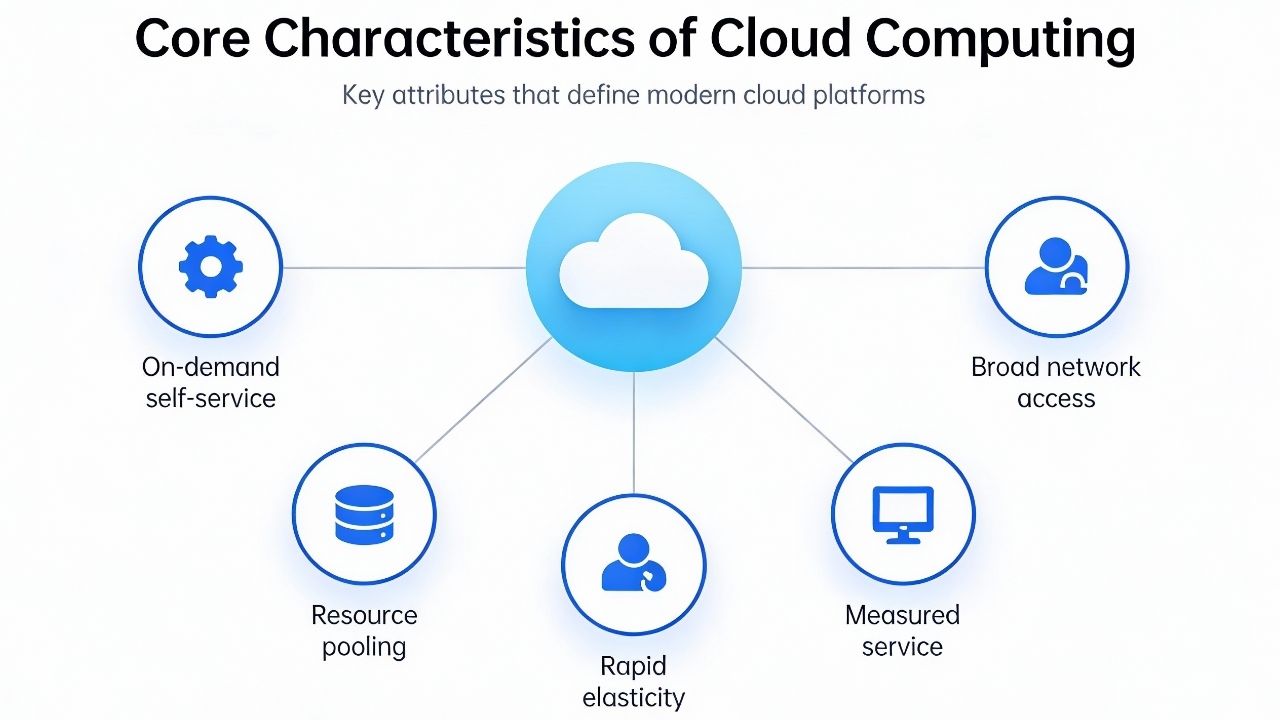
The characteristics of cloud computing are the core traits that define how cloud services are delivered and consumed. According to NIST, five essential characteristics are on demand self service, broad network access, resource pooling, rapid elasticity, and measured service. In practice, teams also consider multi tenancy, pay as you go pricing, automation, high availability, resiliency, and security by design. Together, these properties enable scalable, reliable, and cost efficient computing delivered over the internet.
When teams ask what are characteristics of cloud computing, they’re really asking how the cloud promises speed, reliability, and cost control and how those promises hold up in production. Understanding these traits helps you architect systems that scale smoothly, secure data responsibly, and avoid hidden costs.
This guide breaks down the core NIST characteristics and the additional architectural traits that matter most in real world workloads. You’ll see examples across IaaS, PaaS, and SaaS; learn how elasticity differs from scalability; and get practical guidance on performance, security, governance, and FinOps. Whether you run WordPress, SaaS apps, or enterprise systems, you’ll find actionable insights grounded in field experience.
Core Characteristics of Cloud Computing (NIST-Aligned)
These characteristics are the foundation of modern cloud platforms. They define how resources are delivered. Grasp them well, and you can design portable, resilient, and cost efficient architectures from day one.
On Demand Self Service
On demand self service means you can provision compute, storage, and network resources automatically, without waiting for human approval. In practice, this looks like spinning up a VM, object bucket, or database through an API, CLI, or console, seconds, not days.
For example, a development team can deploy a staging environment from a template, run tests, and shut it down after a successful pipeline. The service catalog is standardized, so the experience is predictable across teams and regions.
Self service drives agility but must be paired with guardrails: quotas, budgets, tagging, and role based permissions. That balance lets you move fast without losing control over cost or security.
Broad Network Access
Broad network access ensures services are available over standard networks and devices. Whether you’re on a laptop, phone, or edge gateway, you access cloud endpoints via the internet or private links using HTTP(S), gRPC, SSH, or VPN.
This characteristic also implies performance considerations: edge locations, CDNs, regional latency, and bandwidth. A WordPress site backed by a CDN and edge caching delivers faster pages globally, while private connectivity (such as Direct Connect/ExpressRoute) helps enterprises maintain predictable throughput and security.
Design APIs and web apps with adaptive retries, TLS everywhere, and health aware routing to survive network variability and achieve consistent user experience.
Resource Pooling
Resource pooling describes how providers serve multiple customers using a shared pool of compute, storage, and network. Behind the scenes, virtualization and containerization abstract physical hosts to deliver isolated environments with logical tenancy.
For customers, pooling means elastic capacity and standardized instances. For providers, it enables high utilization and economies of scale. Isolation is enforced with hypervisors, cgroups, namespaces, and software defined networking.
To leverage pooling safely, enforce workload isolation, least privilege networking, encryption at rest and in transit, and per-tenant keys. For compliance heavy apps, consider dedicated hosts or private clouds while still benefiting from managed services.
Rapid Elasticity (and Scalability)
Rapid elasticity means capacity grows or shrinks automatically as load changes. Scalability means the system can handle growth, often via horizontal scaling (more instances) or vertical scaling (bigger instances). Elasticity is dynamic; scalability is capability.
Real world example: an eCommerce store scales out from 4 to 40 web instances during a flash sale, then scales back at night. With container orchestration, autoscalers increase replicas when CPU, memory, or custom SLOs breach thresholds.
Design for statelessness, externalize sessions to Redis, and use read replicas for databases. Elasticity works best when scale operations are automated, fast, and safe—no manual steps, no schema locks at peak time.
Measured Service
Measured service means usage is metered, by instance hours, requests, bytes stored, I/O, or egress and billed accordingly. This transparency is key to cost control and accountability across teams.
Set budgets and alerts, tag resources by owner, app, and environment, and review cost by dimension (compute, storage, network). Use cost allocation to map spend to business value and reduce idle capacity through schedules and rightsizing.
FinOps practices, regular cost reviews, shared metrics, and showback/chargeback, turn measured service into a competitive advantage rather than a surprise line item.
Additional Architectural Traits That Matter in Practice
Beyond the NIST five, engineers rely on traits that keep systems robust at scale. These complement the core model.
They influence uptime, security posture, recovery speed, and total cost. Ignore them and you pay later.
Multi Tenancy and Isolation
Multi tenancy allows multiple customers to share the same platform while remaining logically isolated. Isolation controls include dedicated VPCs/VNETs, IAM boundaries, KMS key separation, and per tenant data stores.
For SaaS, tenant aware routing and row level security limit data access. For hosting workloads, WAF rules, per site PHP pools, and filesystem isolation reduce lateral movement risks between sites on shared infrastructure.
When assessing providers, ask how noisy neighbor effects are mitigated—CPU pinning, I/O throttles, and fairness algorithms all protect performance consistency.
High Availability and Fault Tolerance
High availability (HA) keeps services running through failures, while fault tolerance lets components fail without user visible impact. In cloud platforms, HA often means spreading instances across availability zones (AZs) with health checks and self healing.
Practical patterns include multi AZ load balancing, managed database failover, and message queues to decouple services. Use circuit breakers and timeouts to avoid cascading failures. Aim for error budgets that reflect your SLA targets.
For WordPress, frontends behind a load balancer with read replicas and object caching (Redis/Memcached) improve resilience. Storing media in object storage adds durability with cross region replication.
Automation and Orchestration
Automation translates policies into repeatable actions; orchestration coordinates those actions across systems. Infrastructure as Code (IaC) creates versioned, testable environments; CI/CD standardizes delivery; autoscalers and operators keep services healthy.
Benefits include faster recovery, consistent configurations, and lower change failure rate. Start with IaC for networks, compute, and databases, then extend to policy as code for security and compliance.
Combine automation with approvals where risk is high (production schema changes), and with full autonomy where risk is low (dev environment cleanup).
Security and Compliance by Design
Security is a first class characteristic: identity first access, encryption, micro segmentation, and continuous monitoring. Cloud providers offer shared responsibility, providers secure the infrastructure; you secure configurations, data, and identities.
Baseline controls: MFA and least privilege IAM, customer managed keys, private subnets, WAF/IDS, patch automation, and posture management (CSPM). Map controls to frameworks like ISO 27001, SOC 2, PCI DSS, HIPAA, or GDPR.
Build secure defaults into templates so every new workload inherits guardrails automatically, this reduces audit overhead and human error.
Observability and FinOps
Observability ties metrics, logs, and traces together for fast diagnosis and capacity tuning. FinOps applies similar discipline to cost, turning measured service into business insights.
Instrument apps with SLOs, error budgets, and golden signals (latency, traffic, errors, saturation). For costs, enforce tags, budgets, and dashboards by team and service. Meet monthly to review anomalies and savings opportunities.
The result is a tight feedback loop: performance data informs scaling policies; cost data informs instance choices and schedules.
Service and Deployment Models Shape These Characteristics
How you consume the cloud changes how these traits behave. Models trade flexibility for simplicity.
Choose IaaS, PaaS, or SaaS based on control needs. Pick public, private, hybrid, or multi cloud for risk and reach.
Cloud Service Models
IaaS (Infrastructure as a Service)
IaaS offers virtualized compute, storage, and networking. You manage OS, runtime, and applications; the provider manages the underlying hardware and hypervisor. It maximizes flexibility and is ideal for lift and shift migrations and custom stacks.
Characteristics in action: strong self service, broad network access, and elasticity via autoscaling groups. Measured service is granular, instance hours, block storage IOPS, snapshots, and egress. You own patching and hardening.
PaaS (Platform as a Service)
PaaS abstracts OS and middleware so teams focus on code. Think managed databases, serverless functions, and application platforms. It accelerates delivery and enforces opinionated defaults.
Characteristics shift toward automation, standardized security, and fine grained scaling (per request or per function). Costs are performance based: queries, invocations, or connection units instead of instance size.
SaaS (Software as a Service)
SaaS delivers finished applications over the web, email, CRM, analytics, or managed WordPress panels. You configure features; the provider runs the stack. Time to value is high, but customization is limited.
The dominant characteristics here are multi tenancy, high availability, and measured service by seat, storage, or usage tier. Data residency, backup guarantees, and export options become critical evaluation points.
Deployment Models
Public Cloud: Public cloud offers the broadest service catalog, elastic capacity, and global reach. It’s ideal for variable workloads, modern apps, and global audiences, with strong automation and measured service telemetry.
Private Cloud: Private cloud delivers similar characteristics inside your data center or a dedicated hosting environment. You gain control and data locality but trade off some elasticity and managed services breadth.
Hybrid and Multi Cloud: Hybrid mixes on premises with public cloud; multi cloud spans multiple providers. These models aim for resilience, compliance, and vendor flexibility, but add complexity in networking, identity, and cost management.
Performance, Scalability, and Elasticity in the Real World
Fast systems start with good architecture, not just bigger instances. Treat capacity as code.
Measure with SLOs, automate scale, and cache aggressively. Then optimize the hotspots you find.
Capacity Planning vs. Auto Scaling
Capacity planning forecasts baseline resources; auto scaling handles volatility. You still need both. Plan steady state capacity for typical load and growth, then let auto scaling absorb spikes and failures.
Define scale triggers aligned to user experience: queue depth, p95 latency, or custom business metrics, not just CPU. Include cool downs to avoid thrash and pre warm caches before expected surges.
Horizontal vs. Vertical Scaling
Horizontal scaling adds instances; vertical scaling increases instance size. For stateless services, horizontal scaling is safer and cheaper. For stateful monoliths, vertical scaling may be necessary until you can shard or split the service.
Balance the two: rightsize instance types for efficiency, then scale out for resilience. Use managed databases with read replicas and consider partitioning strategies as data grows.
Stateless Services, Caching, and Queues
Stateless frontends let you scale quickly. Move sessions to Redis, persist media to object storage, and cache aggressively at the CDN, application, and database layers. Use queues to smooth bursty workloads and protect downstream services.
These patterns are foundational to achieving the elasticity cloud platforms promise—and to keeping costs stable when traffic fluctuates.
Sample Auto Scaling Policy (Conceptual)
# Scale web tier based on latency and CPU
policy:
  metric_any:
    - http_latency_p95_ms > 300 for 3m
    - cpu_utilization_pct > 70 for 5m
  scale_out: +2 instances (max 40)
  scale_in: -1 instance (min 4)
  cooldown: 180s
  prewarm:
    - warm_cache: true
    - run_healthcheck: /readyz
Reliability, Disaster Recovery, and SLAs
Uptime is engineered, not promised. Plan for failure at the instance, AZ, and region levels.
Translate business impact into RTO/RPO targets, then choose the right architecture and spend.
RTO, RPO, and Business Alignment
Recovery Time Objective (RTO) is how long you can be down. Recovery Point Objective (RPO) is how much data you can lose. Map each app to RTO/RPO targets and select architectures, active/active, pilot light, warm standby, accordingly.
Not every workload needs zero downtime. Spend where user or revenue impact justifies it, and document acceptable tradeoffs for stakeholders.
Multi AZ and Multi Region Patterns
Multi AZ deployments guard against data center failures. Multi region protects against large scale outages and regional events. Global services often front endpoints with anycast DNS and regional failover while keeping data replicated and consistent.
Be explicit about consistency models. Use async replication for low latency reads and plan conflict resolution if you write in multiple regions.
Backup, Testing, and Runbooks
Backups are table stakes; restores are the proof. Schedule full and incremental backups, encrypt them, and test recovery regularly. Keep immutable copies and retention policies that meet legal requirements.
Runbooks and chaos drills turn theory into muscle memory. Track mean time to recovery (MTTR) and run post incident reviews to improve.
SLAs, SLOs, and Error Budgets
Cloud providers publish SLAs, but your users experience your SLOs. Define SLOs for availability and latency, measure them, and use error budgets to decide deployment pace. When budgets are low, pause risky changes and focus on reliability.
Read provider SLAs carefully, maintenance windows, credit caps, and exclusions matter when negotiating risk and cost.
Security, Governance, and the Shared Responsibility Model
Cloud security is shared. Providers harden infrastructure; you configure and monitor your stack. Strong identity, network segmentation, and encryption turn shared responsibility into shared success.
Identity and Access Management
Centralize identities, enforce MFA, and grant least privilege with roles and scoped policies. Use short lived credentials, service identities, and workload identity federation instead of long lived keys. Rotate secrets automatically.
Apply segregation of duties: developers deploy; platform teams control guardrails; security reviews high risk changes. Log every access and integrate with SIEM for audit trails.
Network Segmentation and Zero Trust
Design private networks with subnets by tier (web, app, data). Deny by default, allow least privilege via security groups and network ACLs. For public endpoints, use WAFs, DDoS protection, and TLS 1.2+.
Move toward zero trust: authenticate and authorize every request, even inside the network. Mutual TLS and service meshes help enforce this at scale.
Data Protection and Compliance
Encrypt data in transit and at rest with customer managed keys and rotation policies. Classify data, restrict export paths, and apply tokenization or pseudonymization where applicable.
Align controls to frameworks required by your industry. For GDPR, confirm data residency, lawful bases, and data subject rights workflows. For PCI, minimize scope via network segmentation and managed services that are already assessed.
Cost Models and Measured Service in Practice
Cloud costs follow your architecture and habits. Visibility and governance turn spend into ROI.
Use tags, budgets, and regular reviews. Optimize idle resources, rightsize, and choose the right plans.
Pricing Models and Commitments
Cloud uses pay as you go for flexibility, with discounts for commitments (reserved instances, savings plans) and spot/preemptible capacity for batch jobs. Managed services may bill by requests, storage, or throughput, read the meters carefully.
Map workloads to models: production databases on reserved nodes for stability, CI runners on spot for savings, and dev environments on schedules to shut down after hours.
FinOps Tips That Deliver Quick Wins
Establish mandatory tagging and cost centers. Automate idle cleanup, set lifecycle policies for object storage, and compress logs. Rightsize instances quarterly and pick balanced CPU/RAM profiles that match actual usage.
Model egress costs early, CDN offload, regional proximity, and private links can cut fees drastically. Finally, track unit economics (cost per request, per order, or per site) to align engineering with business outcomes.
Common Misconceptions and Pitfalls
Misunderstandings about cloud characteristics can cause outages or bill shock. Avoid these traps. Validate assumptions with tests, budgets, and chaos drills. Then automate what works reliably.
- “Cloud is automatically cheap.” Not without rightsizing, schedules, and cost controls.
- “Elasticity fixes bad code.” It only buys time; performance issues still cost money.
- “SLA equals uptime guarantee.” Credits don’t restore trust—architect for resilience.
- “Managed means secure.” You still own configuration, identities, and data protection.
- “Multi cloud prevents lock in.” It can, but increases complexity—measure total cost.
- “Backups mean safe data.” Only tested restores prove your recovery plan works.
Technical and Operational Checklist
- Elasticity and HA: Multi AZ by default? Health checks and self healing in place?
- Performance: Instance families, storage IOPS tiers, CDN/edge options, and latency figures.
- Security: IAM maturity, KMS, default encryption, WAF/DDoS, posture management tools.
- Compliance: Documented certifications, data residency options, and audit support.
- Networking: Private connectivity, IPv6 readiness, and granular firewalling.
- Observability: Integrated metrics/logs/traces, SLO tooling, and alerting integrations.
- Cost controls: Budgets, anomaly detection, granular meters, and commitment discounts.
- Support: SLAs, response times, escalation paths, and access to engineers.
FAQs
What are the five essential characteristics of cloud computing?
The five essential characteristics, per NIST, are on demand self service, broad network access, resource pooling, rapid elasticity, and measured service. These traits define how cloud resources are provisioned, accessed, shared, scaled, and billed.
How do elasticity and scalability differ in the cloud?
Scalability is a system’s ability to handle growth, often by adding resources. Elasticity is automatic, real time scaling up or down in response to load. You design for scalability and configure policies to achieve elasticity.
What is resource pooling and why does it matter?
Resource pooling means multiple customers share standardized infrastructure with logical isolation. It delivers elastic capacity and lower costs through higher utilization, while isolation controls keep workloads secure and performant.
Which deployment model offers the best reliability?
Public cloud offers broadest multi AZ and multi region options, but the “best” reliability depends on your architecture and RTO/RPO goals. Hybrid or multi cloud can improve resilience if you manage added complexity well.
How does measured service help control cloud costs?
Measured service provides granular usage metrics by resource and team. With tags, budgets, alerts, and commitment discounts, you can attribute spend, find waste, rightsize resources, and align costs to business value.
Are managed services more secure than IaaS?
Managed services often ship with secure defaults and reduce your operational attack surface. However, security still depends on your configurations and access controls. The shared responsibility model applies regardless of service type.
u003cstrongu003eWhat characteristics should WordPress users prioritize?u003c/strongu003e
Focus on broad network access (CDN and edge caching), rapid elasticity (autoscaling frontends), high availability (multi AZ), and measured service (clear storage and egress costs). Managed backups, WAF, and object storage for media are key.
Conclusion
The characteristics of cloud computing are more than buzzwords, they’re engineering constraints and opportunities. Master the NIST essentials, reinforce them with automation, security, and observability, and align your architecture to business goals.
Do that, and you’ll deliver faster, safer, and more cost effective services, whether you’re powering a global SaaS platform or a high traffic WordPress site.